 MSK
MSK
- About
- Browse Articles
-
Special Issues
- Pioneering strategies for overcoming bacterial drug resistance (2026)
- Advancing microbial engineering through synthetic biology (2025)
- Host-associated microbiome (2024)
- Bacterial regulatory mechanisms for the control of complex cellular mechanisms (2023)
- Two years into COVID-19 pandemic: Where are we? (2022)
- Collections
- For Contributors
- Policies
- E-Submission

- About
- Browse Articles
-
Special Issues
- Pioneering strategies for overcoming bacterial drug resistance (2026)
- Advancing microbial engineering through synthetic biology (2025)
- Host-associated microbiome (2024)
- Bacterial regulatory mechanisms for the control of complex cellular mechanisms (2023)
- Two years into COVID-19 pandemic: Where are we? (2022)
- Collections
- Policies
- For Contributors
Articles
- Page Path
- HOME > J. Microbiol > Volume 64(2); 2026 > Review
-
Review
Armored RNA technology as a clinical diagnostics tool for future pandemic preparedness - Jin Hao Tan1, Prashant Mainali1, Wei Zhang2, Dave Siak-Wei Ow1,*
-
Journal of Microbiology 2026;64(2):e2510016.
DOI: https://doi.org/10.71150/jm.2510016
Published online: February 28, 2026
1Microbial Cell Bioprocessing, Bioprocessing Technology Institute (BTI), Agency for Science, Technology and Research (A*STAR), Singapore 138668, Republic of Singapore
2Downstream Processing, Bioprocessing Technology Institute (BTI), Agency for Science, Technology and Research (A*STAR), Singapore 138668, Republic of Singapore
- *Correspondence Dave Siak-Wei Ow dave_ow@a-star.edu.sg
• Received: October 21, 2025 • Revised: December 17, 2025 • Accepted: December 31, 2025
© The Author(s), under exclusive licence to Microbiological Society of Korea 2026
This is an Open Access article distributed under the terms of the Creative Commons Attribution 4.0 International License (CC BY 4.0) (https://creativecommons.org/licenses/by/4.0/) which permits unrestricted use, distribution, and reproduction in any medium, provided the original work is properly cited.

Supplementary Information
References
Citations
Citations to this article as recorded by 
- Development, Characterization, and Validation of an MS2 Phage-Based Armored RNA Control for Schmallenberg Virus Detection
Mengqi Zhao, Yibo Wang, Yifei Xie, Jianshuai Gao, Boyuan Zhang, Huitong Li, Dan Liu, Hui Jiang, Guangzhi Zhang, Pengtao Jiao, Jiabo Ding, Jinling Liu, Qingchun Shen
Pathogens.2026; 15(8): 865. CrossRef
 Cite this Article
 XML Download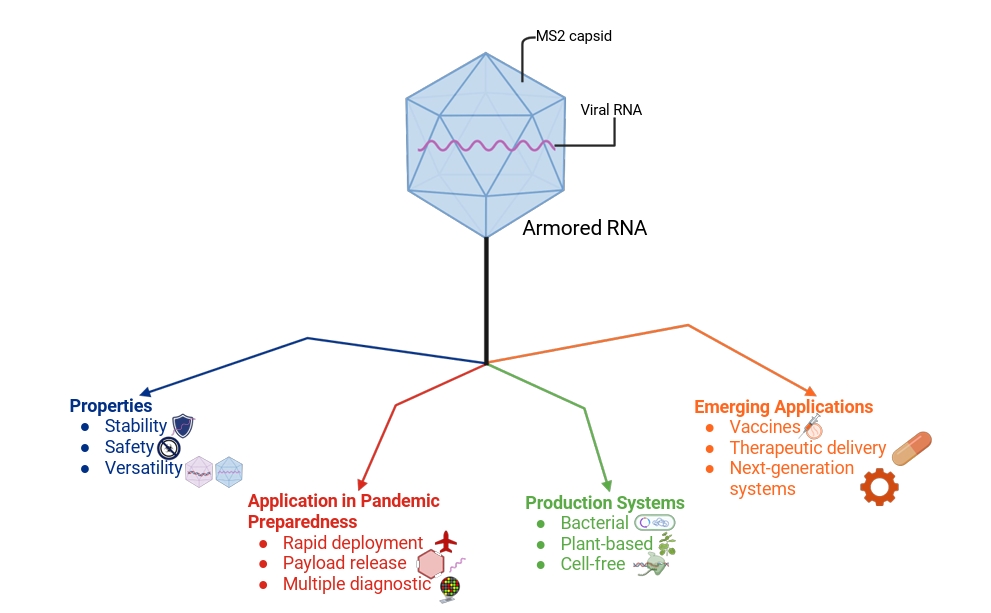
Armored RNA technology as a clinical diagnostics tool for future pandemic preparedness
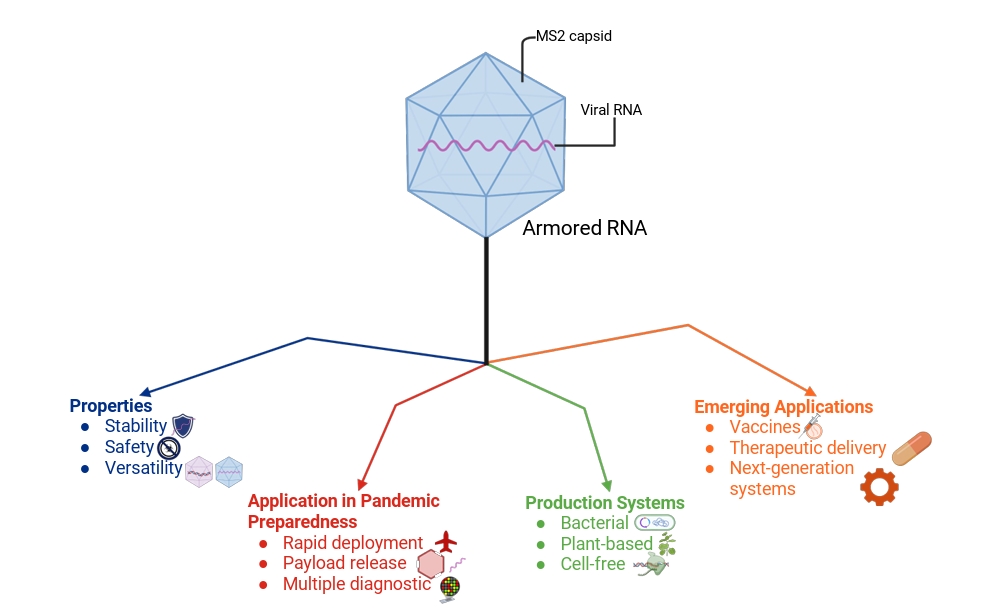
Fig. 1. Schematic Overview of Armored RNA and its Key Attributes. Schematic illustration of an armored RNA particle composed of viral RNA encapsidated within an MS2 bacteriophage icosahedral capsid. Arrows highlight the main themes discussed in the review: (i) Properties – notably stability, biosafety, and versatility in packing diverse nucleic acid types; (ii) Applications in pandemic preparedness – such as rapid deployment and payload release of molecular standards, and multiplex RT-PCR diagnostics; (iii) Production systems – including bacterial expression, plant-based expression, and cell-free assembly; and (iv) Emerging applications – including roles of aRNA in vaccines, therapeutic RNA delivery, and next-generation engineered capsid systems. Created with BioRender.com.
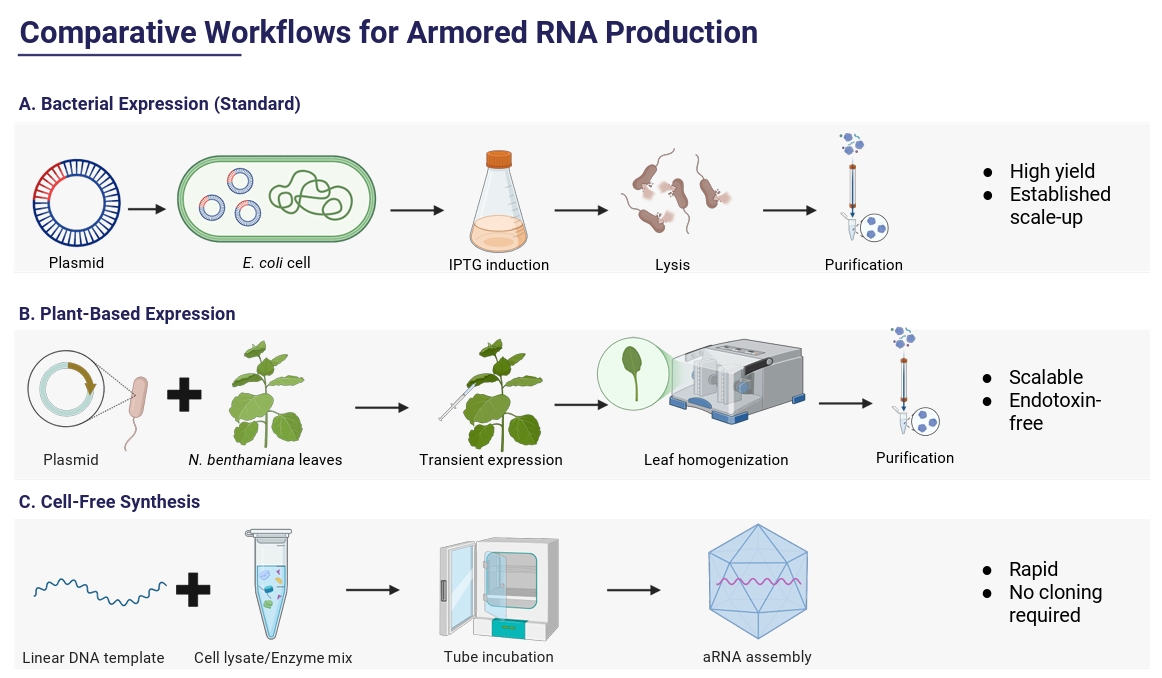
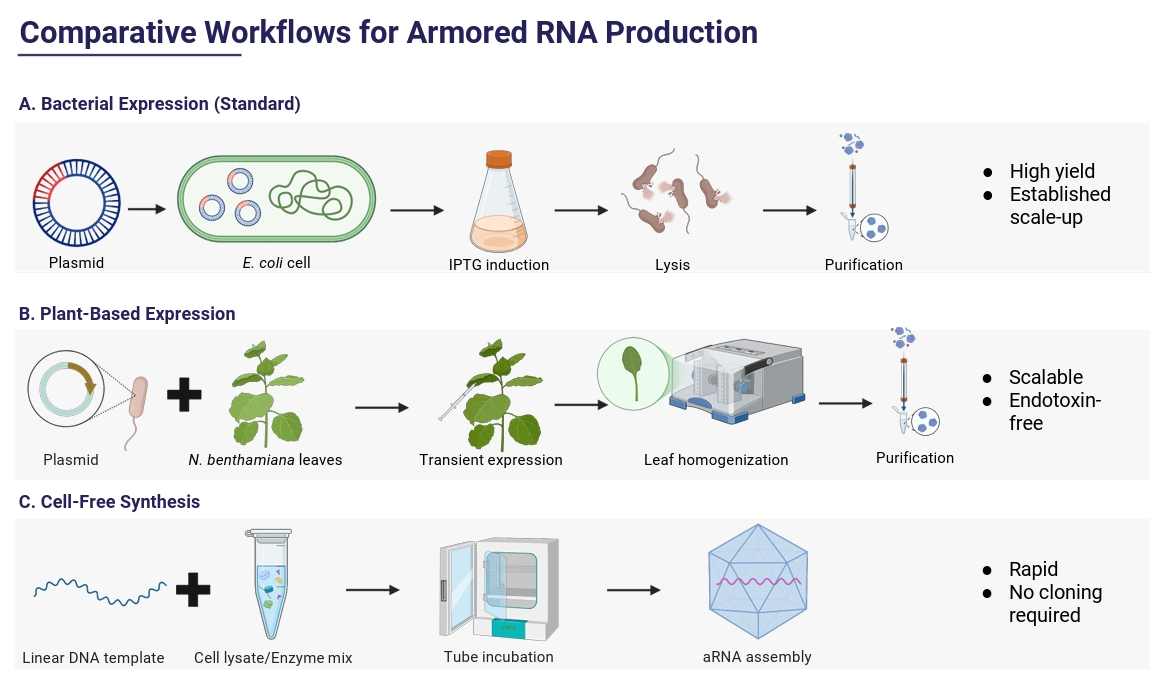
Fig. 2. Comparison of Armored RNA Production Platforms. (A) The canonical E. coli expression system involves plasmid transformation and induction, offering high yields with established scale-up processes. (B) Plant-based systems utilize Agrobacterium-mediated transient expression in Nicotiana benthamiana, producing stable particles free of bacterial endotoxins. (C) Cell-free systems allow for rapid assembly from linear DNA templates without the need for cell culture, though at a higher reagent cost. Created with BioRender.com.
Fig. 1.
Fig. 2.
Armored RNA technology as a clinical diagnostics tool for future pandemic preparedness
| Publication year | Viral target | Production system | RT-PCR limit of detection (LOD) | Reference |
|---|---|---|---|---|
| 1998 | HIV-1 | E. coli DH5α | Not tested | |
| 1999 | Hepatitis C | E. coli DH5α | Not tested | |
| 2005 | Enterovirus | Not specified | Not specified | |
| 2006 | Classical swine fever virus (CSFV), foot-and-mouth disease virus (FMDV), vesicular stomatitis virus (VSV) | Cell-free production | 102 to 103 copies for CSFV, and 103 to 104 copies for FMDV, 10 to 102 target copies for VSV | |
| 2007 | Rebulla | E. coli | Not specified | |
| 2007 | Influenza A, influenza B, SARS | E. coli BL21 (DE3) | 101 copies/μl of AR-2 | |
| 2008 | SARS-CoV | E. coli DH5α | 25 copies/reaction | |
| 2009 | HIV-1 | E. coli BL21 (DE3) | 50 copies/ml | |
| 2010 | Influenza A, influenza B, RSV, H1N1 | E. coli DH5α | Not reported | |
| 2011 | EV71, CA16, pan-EV | E. coli DH5α | Not reported | |
| 2013 | Influenza A (H1N1, H5N1, H9N2) | E. coli DH5α | 100–101 copies/ml | |
| 2013 | Influenza A (H7N9) | E. coli BL21 (DE3) | Not reported | |
| 2015 | Foot-and-mouth disease | Nicotiana benthamiana | Not reported | |
| 2015 | Measles | E. coli BL21 (DE3) | Not reported | |
| 2015 | HBV, HPV | E. coli BL21 (DE3) | Not tested | |
| 2016 | MERS-CoV | E. coli BL21 (DE3) | Not reported | |
| 2020 | SARS-CoV-2 | E. coli BL21 (DE3) | 103 copies/ml | |
| 2021 | Zika | E. coli BL21 (DE3) | Not reported | |
| 2022 | SARS-CoV-2 | Nicotiana benthamiana | Not reported | |
| 2024 | nOPV2 poliovirus | E. coli BL21 (DE3) | 103 copies/ml | |
| 2025 | Measles | E. coli BL21 (DE3) | 103 copies/ml |
| Characteristic | Bacterial systems | Plant-based systems | Cell-free production |
|---|---|---|---|
| Production speed | Fast (hours–1 day) | Slower (days for transient expression) | Very fast (hours, no growth) |
| Yield | High, scalable in fermenters | Moderate; variable per biomass | Lower but adequate for small batches |
| Cost | Low | Moderate–high | High per unit; economical only at small scale |
| Assembly complexity | Well-established but may need optimization | Handles complex VLPs; more variable | Highly controlled but technically demanding |
| Product quality & Stability | Good if purified; risk of endotoxin | Batch variability; plant contaminants possible | High control; must guard against RNase |
| Biosafety | Non-infectious, low risk | Low pathogen risk after purification | Extremely low risk; no living host |
| Scalability | Easy to scale to bioreactors | More space and resources needed; feasible | Limited by reagent cost and supply |
| Regulatory/Contaminants | Well understood; bacterial nucleic acids must be removed | Less established; possible plant compounds | Few biological contaminants; reagent purity critical |
| Storage & Shipping | Stable when frozen/lyophilized | Similar to bacterial system after purification | Most flexible; can be lyophilized, potentially room-temperature stable |
Table 1. List of viral target positive controls that armored RNA has been developed for
Table 2. Comparison between bacterial, plant-based, and cell-free production systems
Table 1.
Table 2.
TOP


