ABSTRACT
- Chronic stress is a major risk factor for depression and anxiety. However, individuals differ markedly in stress susceptibility and resilience. Accumulating preclinical and clinical evidence indicates that the gut microbiota is closely associated with stress-related phenotypes through the immune, endocrine, and neural pathways. Alterations in microbial diversity, short-chain fatty acid production, and tryptophan metabolism have been associated with stress-related neuroendocrine and immune regulation, whereas emerging preclinical evidence suggests potential links to neural circuits involved in reward processing. By integrating findings from microbiome research and systems neuroscience, this review proposes a microbiology-centered framework for understanding stress resilience and stress-induced anhedonia. Beyond merely summarizing the existing evidence, we critically evaluate the methodological challenges in current human and preclinical studies and highlight the critical need for standardized approaches and multi-omics integration to decipher causality and develop precise psychobiotic interventions.
-
Keywords: anhedonia, gut microbiota, microbiota–gut–brain axis, reward circuitry, stress resilience, psychobiotics
Introduction
Chronic stress is a major risk factor for depression and anxiety disorders; however, individuals exposed to similar stressors exhibit substantial variability in stress susceptibility and resilience (Hammen, 2005; Krishnan et al., 2007; McEwen, 1998). Although prolonged stress can induce maladaptive neuroendocrine and immune alterations, the biological mechanisms underlying individual differences in stress outcomes remain incompletely understood.
Recent evidence suggests that stress-related phenotypes are shaped by both central nervous system processes and systemic biological regulators, including the gut microbiota (Belkaid and Hand, 2014; Cryan and Dinan, 2012; Stephens and Kozik, 2022). Early life microbial colonization influences hypothalamic–pituitary–adrenal (HPA) axis function, highlighting the potential role of the microbiota in stress responsivity (Sudo et al., 2004). Both animal models and human studies have consistently reported associations between chronic stress exposure and altered gut microbial composition and metabolic profiles (An et al., 2024; Delgadillo et al., 2025; Stephens and Kozik, 2022).
Beyond compositional changes, stress-associated dysbiosis is linked to alterations in microbial metabolic pathways, particularly those involving short-chain fatty acid and tryptophan metabolism, which are relevant to immune regulation and neuroendocrine signaling (O'Mahony et al., 2015; Valles-Colomer et al., 2019; Zhou et al., 2023). Growing evidence connects microbiota alterations to stress-induced anhedonia, a core symptom of depression associated with the dysfunction of reward-related neural circuits (Der-Avakian and Markou, 2012; Russo and Nestler, 2013; Stanton et al., 2019). Microbiota manipulation can modify stress-related behavioral phenotypes, suggesting a functional link between the gut microbial ecology and reward processing (Siopi et al., 2023; Yang et al., 2019; Zheng et al., 2016).
The strength and nature of the available evidence differ across experimental settings. Microbiome-depletion, colonization, and transfer studies demonstrate that microbial communities can modify stress-related behavioral phenotypes in rodents. Human studies provide complementary evidence of associations between the gut microbiota and stress-related phenotypes, although their observational designs generally preclude conclusions about directionality. Evidence connecting specific microbial factors to defined alterations in reward circuitry is still emerging. Accordingly, this review distinguishes experimentally supported microbiota–behavior relationships from observational associations and integrative mechanistic frameworks supported by convergent findings.
Stress resilience and stress-induced anhedonia should not be considered opposite ends of a single biological continuum. Stress resilience refers broadly to the capacity to maintain or recover adaptive function following stress exposure, whereas stress-induced anhedonia denotes a specific impairment in reward processing that may occur in stress-susceptible individuals. The two phenotypes may share neuroimmune, neuroendocrine, and metabolic mediators but involve partially distinct biological processes and neural circuits.
Herein, we review preclinical and clinical evidence to examine how stress-associated alterations in the gut microbiota contribute to stress resilience and stress-induced anhedonia. By integrating microbiome research with systems neuroscience, this review aims to provide a microbiology-centered framework for understanding stress-related phenotypes and highlight emerging opportunities for microbiome-targeted interventions.
In contrast to previous reviews that largely treated stress-related outcomes as uniform endpoints, we explicitly distinguish stress resilience from stress-induced anhedonia and anchor both to the circuit-level mechanisms of reward and stress regulation, thereby providing a symptom- and circuit-informed framework that integrates microbiome research with systems neuroscience.
Gut Microbiota & Stress Resilience: Mechanisms and Psychobiotic Interventions
Because stress resilience represents an adaptive capacity rather than simply the absence of anhedonia, we first examine microbiota-associated processes related to the maintenance or recovery of function after stress. We subsequently consider stress-induced anhedonia as a specific reward-processing deficit with partly distinct circuit-level substrates. Stress-related neuropsychiatric disorders, including major depressive disorder, anxiety disorders, and post-traumatic stress disorder, are increasingly recognized as systemic conditions in which bidirectional communication between the gut microbiota and central nervous system is closely involved (Cryan and Dinan, 2012; Cryan et al., 2019; Foster et al., 2017; Morais et al., 2021; Stephens and Kozik, 2022).
FMT and microbiome-remodeling studies support a functional relationship between microbial communities and recovery from chronic stress. In mice, recovery-associated microbiome remodeling and transplantation-related effects have been linked to improved depressive-like behavior, reduced inflammatory signaling, and restoration of hippocampal neurogenesis (He et al., 2024a, 2024b; Siopi et al., 2023). Human studies have reported stress- and resilience-associated differences in microbial composition and functional pathways, although the direction and taxonomic specificity of these associations vary across cohorts (An et al., 2024; Delgadillo et al., 2025; Ying et al., 2025).
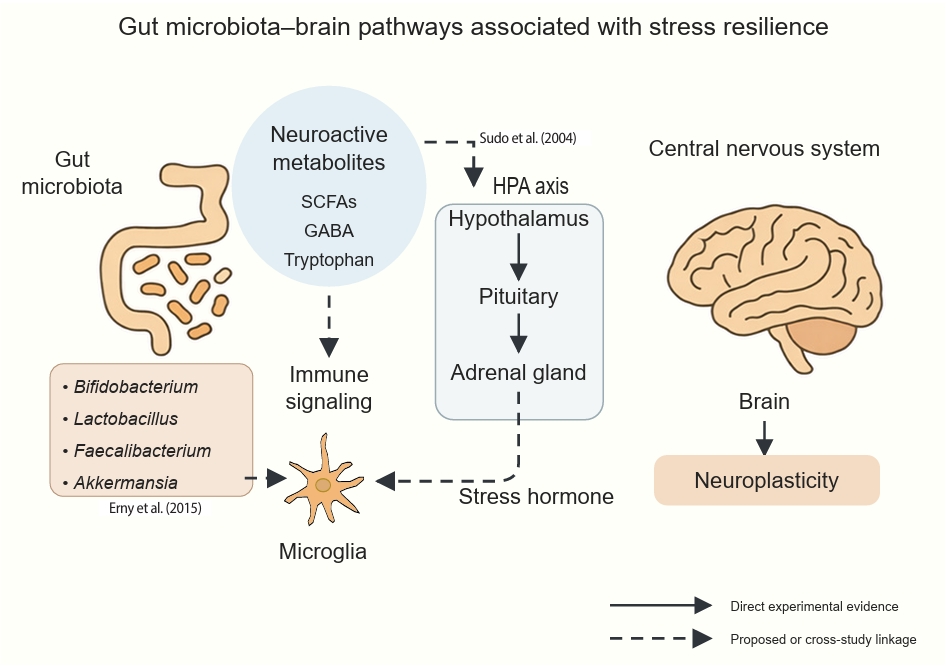
Mechanistically, gut microbes may influence host stress responses through multiple convergent routes: (1) modulating systemic and central inflammation through microbial products and metabolites; (2) producing or modifying neuroactive compounds, including short-chain fatty acids and tryptophan-derived metabolites; (3) regulating HPA-axis activity through vagal and humoral signaling; and (4) modulating blood–brain barrier and microglial functions (Belkaid and Hand, 2014; Erny et al., 2015; Foster et al., 2017; O'Mahony et al., 2015; Sudo et al., 2004).
Collectively, these multiscale interactions provide a conceptual framework for psychobiotic interventions, including targeted probiotics, prebiotics, synbiotics, and FMT, which aim to augment stress resilience. However, heterogeneity in preclinical stress models, lack of standardized psychobiotic formulations, limited longitudinal human trials, and uncertainty regarding mechanism-specific biomarkers continue to constrain their clinical translation. Accordingly, this review synthesizes the current preclinical and clinical evidence, maps mechanistic pathways linking gut microbes to brain circuits relevant to stress resilience, evaluates psychobiotic intervention studies, and proposes an integrated roadmap for future translational research that incorporates standardized endpoints, omics-guided stratification, and mechanistic validation.
Preclinical evidence linking gut microbiota to stress resilience
Preclinical studies using rodent models of chronic stress provide converging evidence that gut microbial composition and function are associated with stress-resilience phenotypes. Stress-resilient and stress-susceptible animals can exhibit distinct microbial and metabolite profiles, and recent mechanistic studies implicate microbial regulation of hippocampal microglia–neuron interactions and neurogenesis (Cryan and Dinan, 2012; He et al., 2024a, 2024b; Tofani et al., 2025; Wang et al., 2023).
Specific example was reported in the chronic social defeat stress model, in which Bifidobacterium was detected in resilient but not susceptible mice, and oral administration of Bifidobacterium increased the proportion of animals displaying a resilient phenotype (Yang et al., 2017). This finding provides experimental support for the involvement of a specific bacterial taxon in stress resilience, although its generalizability across stress paradigms and host populations remains to be established.
Microbiota-transfer and depletion studies further support a causal contribution. Transfer of depression-associated microbiota can induce behavioral and metabolic abnormalities in recipient rodents, whereas recovery-associated microbiome remodeling can ameliorate behavioral deficits and rescue hippocampal neurogenesis (He et al., 2024b; Pinto-Sanchez et al., 2017; Siopi et al., 2023; Zheng et al., 2016). These findings also show that vagal integrity and host metabolic responses can determine the behavioral effects of microbial transfer.
At the functional level, resilient phenotypes have been associated with microbial pathways involving short-chain fatty acids, tryptophan metabolites, circadian regulation, and neuroimmune homeostasis (Erny et al., 2015; He et al., 2024a; O'Mahony et al., 2015; Tofani et al., 2025; Wang et al., 2023). However, taxonomic signals are not uniform across stress paradigms, and heterogeneity in microbial manipulation strategies and behavioral outcomes limits direct comparison across studies. The key preclinical findings are summarized in Table 1.
These preclinical findings provide a framework for evaluating whether analogous microbiota–stress associations are observed in human studies.
Human observational evidence: Stress-related microbiota signatures & metabolites
Human observational studies have associated psychosocial stress, depression, and psychological resilience with differences in gut microbial composition and function (An et al., 2024; Delgadillo et al., 2025; Jiang et al., 2015; Stephens and Kozik, 2022; Valles-Colomer et al., 2019; Ying et al., 2025). Reported signatures include changes in alpha diversity and relative abundances of putatively beneficial or proinflammatory taxa, but no single taxonomic signature has been consistently reproduced across populations.
Beyond taxonomic shifts, metabolomic studies indicate alterations in microbial-derived or microbiota-associated metabolites involved in neuromodulation, including short-chain fatty acids, ammonia, and tryptophan–kynurenine pathway metabolites (O'Mahony et al., 2015; Valles-Colomer et al., 2019; Wang et al., 2023; Zhou et al., 2023). These measures have been associated with affective symptoms, stress-related biomarkers, or host neuroactive pathways, but most findings remain correlational.
Despite these converging associations, most available human datasets remain cross-sectional, with modest sample sizes and substantial heterogeneity in microbiome profiling methods, analytical pipelines, and covariate control (e.g., diet, medication use, and body mass index). Consequently, longitudinal studies incorporating repeated sampling, paired symptom assessments, and integrated multi-omics approaches are required to distinguish state-dependent from trait-like microbial signatures and identify robust candidate biomarkers for microbiome-targeted intervention trials. These findings motivated a closer examination of the mechanistic pathways linking gut microbial activity to stress-related brain function.
Mechanistic pathways linking gut microbiota to stress resilience and anhedonia
Gut microbiota influence stress-related phenotypes through convergent immune, neuroendocrine, neural, and metabolic pathways that link peripheral microbial activity to central stress- and reward-related circuits (Cryan and Dinan, 2012; Foster et al., 2017; Qu et al., 2024; Vuong et al., 2017). These mechanisms provide a biological framework through which microbial perturbations under chronic stress can influence resilience and vulnerability.
Microbiota-associated immune signaling is a core pathway relevant to stress resilience. Chronic stress can increase intestinal permeability and inflammatory signaling, whereas microbial-derived metabolites contribute to microglial maturation and homeostasis (Belkaid and Hand, 2014; Erny et al., 2015; Rohleder, 2014; Stephens and Kozik, 2022). In parallel, gut microbes modulate HPA-axis activity: germ-free animals exhibit exaggerated corticosterone responses to restraint stress that can be partially normalized by early microbial colonization (Sudo et al., 2004).
Gut microbes also contribute to the production and metabolism of neuroactive compounds, including γ-aminobutyric acid and tryptophan-derived metabolites (Strandwitz, 2018). Stress-associated changes in tryptophan metabolism and other microbial metabolic pathways may affect corticolimbic functions involved in motivation and reward processing (O'Mahony et al., 2015; Valles-Colomer et al., 2019; Wang et al., 2023; Zhou et al., 2023). The principal mechanistic pathways connecting the gut microbiota to stress resilience and stress-induced anhedonia are summarized in Table 2 and schematically illustrated in Fig. 1.
Translational implications: Microbiome-targeted strategies for stress resilience
Growing mechanistic insight into microbiota–stress interactions has stimulated interest in microbiome-targeted strategies aimed at enhancing stress resilience and mitigating stress-related psychopathology. Psychobiotic approaches, including targeted probiotics, prebiotics, and dietary interventions, can modulate behavioral and neuroendocrine outcomes in some preclinical and human studies, although effects are strain-, population-, and endpoint-dependent (Cryan and Dinan, 2012; Chong et al., 2019; Foster et al., 2017; Lew et al., 2019).
In humans, several controlled trials have reported modest improvements in stress, anxiety, mood, or cognitive reactivity after specific probiotic or prebiotic interventions (Chong et al., 2019; Lew et al., 2019; Steenbergen et al., 2015). However, a well-characterized preclinical psychobiotic strain failed to improve stress or cognitive outcomes in healthy men (Kelly et al., 2017), and systematic reviews emphasize heterogeneity in formulations, populations, intervention duration, and outcome measures (Wallace and Milev, 2017).
A mechanism-based precision psychobiotic framework would move beyond the uniform application of candidate strains across heterogeneous populations. First, individuals could be stratified according to clinically relevant stress-related phenotypes and symptom domains, such as reduced stress resilience or anhedonia. Microbiome functional profiles and microbial metabolites could then be integrated with host inflammatory and neuroendocrine markers to identify the dominant biological alteration. Interventions could subsequently be selected to target that alteration—for example, by addressing reduced SCFA-related functions, altered tryptophan metabolism, excessive inflammatory signaling, or dysregulated HPA-axis activity—and microbial, host, and symptom responses could be monitored longitudinally. Standardized formulations and predefined mechanistic and clinical endpoints would be required to determine whether the selected intervention engages its intended target. This framework remains hypothetical and requires prospective validation, but it provides a testable strategy for mechanism-guided strain selection and multi-omics integration.
Although these approaches primarily aim to enhance stress resilience, chronic stress often manifests through specific symptom domains rather than global vulnerability. In particular, anhedonia, a core feature of stress-related disorders, has been increasingly linked to microbiota-associated modulation of reward-related brain circuits, as discussed in the following section.
Microbiome–Brain Circuit Interactions in Stress-Induced Anhedonia
Anhedonia, defined as reduced capacity for pleasure or motivation, is a core symptom dimension of stress-related psychiatric disorders and a robust outcome in chronic-stress models (Der-Avakian and Markou, 2012; Stanton et al., 2019; Willner, 2017). Reward-related dysfunction involves distributed mesocorticolimbic circuits, particularly the medial prefrontal cortex (mPFC), nucleus accumbens (NAc), and ventral tegmental area (VTA) (Russo and Nestler, 2013; Stanton et al., 2019; Xia et al., 2025).
The gut microbiota may influence these circuits through immune, endocrine, neural, and metabolic signaling, positioning the microbiota–gut–brain axis as a potential upstream modulator of reward processing under stress (Cryan and Dinan, 2012; Felger and Treadway, 2017; Foster et al., 2017). Preclinical microbiome-manipulation studies demonstrate that gut microbial changes can modify depression-related or anhedonia-like behaviors, supporting a functional link between microbial dynamics and reward dysfunction (Siopi et al., 2023; Yang et al., 2019; Zheng et al., 2016).
Building on this framework, the following sections examine the behavioral paradigms used to operationalize anhedonia (B1), delineate circuit-level substrates of reward dysfunction (B2), and evaluate microbiota-associated mechanistic mediators (B3), before discussing translational implications (B4).
Behavioral paradigms for assessing stress-induced anhedonia
Anhedonia is operationalized in preclinical stress models using behavioral paradigms that assess reward sensitivity, motivation, and hedonic valuation. The sucrose preference test is commonly used to index consummatory anhedonia, whereas intracranial self-stimulation, progressive-ratio, effort-based choice, and social interaction paradigms capture partly distinct motivational components (Der-Avakian and Markou, 2012; Der-Avakian et al., 2014; Dieterich et al., 2021; Fetcho et al., 2024; Stanton et al., 2019).
Chronic unpredictable mild stress and social defeat stress can induce anhedonia-like and motivational deficits, although substantial individual variability is observed (Der-Avakian et al., 2014; Dieterich et al., 2021; Krishnan et al., 2007; Willner, 2017). This variability has motivated efforts to identify biological predictors and circuit mechanisms of stress susceptibility and resilience (Hing et al., 2024; Xia et al., 2025).
Microbiome-focused studies show that antibiotics, probiotics, or microbial transfer can influence stress-related affective behavior in rodents. Transfer of depression-associated or stress-triggered microbiota can induce behavioral deficits in recipient animals, whereas recovery-associated microbiota can improve behavioral and neurogenic outcomes (He et al., 2024b; Pinto-Sanchez et al., 2017; Siopi et al., 2023; Yang et al., 2019; Zheng et al., 2016). Specifically, fecal microbiota transplantation from chronic social defeat stress-susceptible mice induced an anhedonia-like phenotype and reduced the expression of the synaptic proteins GluA1 and PSD-95 in the prefrontal cortex of antibiotic-treated recipient mice. Subsequent administration of two candidate bacterial species, Lactobacillus intestinalis and Lactobacillus reuteri, reproduced these behavioral and synaptic alterations, whereas subdiaphragmatic vagotomy prevented their development (Wang et al., 2020). These findings provide direct preclinical evidence that specific microbial factors can influence anhedonia-related behavior through vagal signaling, while their effects on the broader mPFC–NAc–VTA reward circuit remain to be further investigated.
The key behavioral paradigms used to assess stress-induced anhedonia and their associated neural substrates are summarized in Table 3, which collectively highlight convergent behavioral and circuit-level disruptions across distinct stress models and underscore the robustness of reward circuit dysfunction as a substrate of stress-induced anhedonia.
Reward circuit substrates underlying stress-induced anhedonia
Stress-induced anhedonia is underpinned by functional and structural changes within mesocorticolimbic reward circuits, most prominently the mPFC, NAc, and VTA. Chronic stress can disrupt dopaminergic and corticostriatal signaling in this network, impairing reward valuation, motivation, and reinforcement learning (Der-Avakian et al., 2014; Fetcho et al., 2024; Russo and Nestler, 2013; Stanton et al., 2019; Xia et al., 2025).
At the circuit level, stress alters excitatory–inhibitory balance and synaptic plasticity across interconnected reward-system nodes. Experimental manipulation of VTA dopamine neurons and mesolimbic BDNF signaling demonstrates causal contributions to susceptibility and resilience, while prefrontal and frontostriatal circuits regulate social and effortful reward-related behavior (Abe et al., 2019; Berton et al., 2006; Chaudhury et al., 2013; Fetcho et al., 2024; Krishnan et al., 2007). These adaptations show marked interindividual variability, mirroring behavioral differences in stress susceptibility and resilience.
Peripheral signals associated with gut microbiota, including inflammatory mediators, microbial-derived metabolites, and stress hormones, represent plausible modulators of reward-related circuits. In particular, experimental and clinical evidence shows that inflammation can impair dopaminergic function and motivated behavior (Erny et al., 2015; Felger and Treadway, 2017; Foster et al., 2017). These findings support the potential involvement of these signals in microbiota–reward circuit communication, although their direct effects on defined reward circuits require further investigation.
Microbiota-associated mechanisms modulating reward circuitry under stress
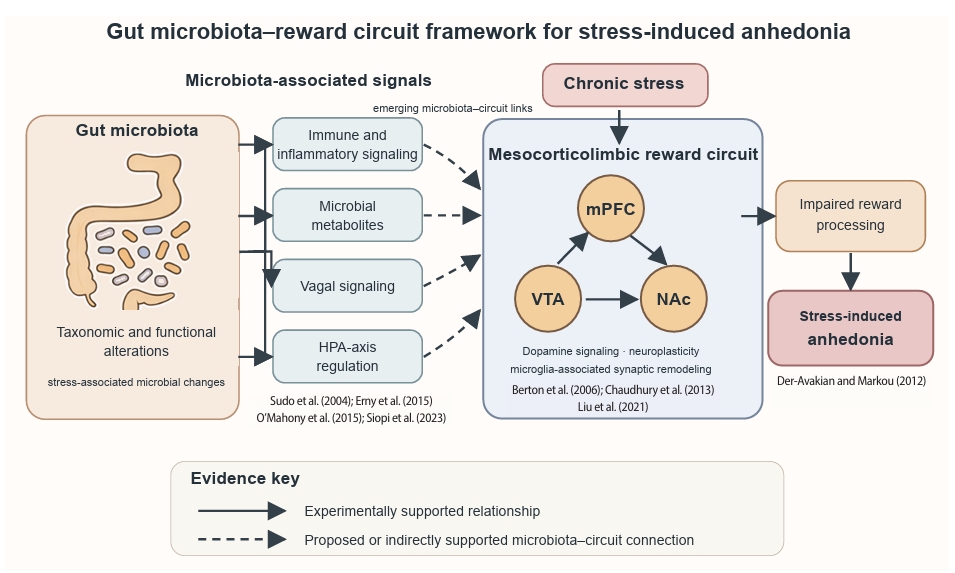
Evidence directly linking microbiota-derived factors to defined alterations in reward circuitry remains limited. Current support for a microbiota–reward circuit connection is derived largely from the convergence of two comparatively well-developed bodies of evidence: microbiota-manipulation studies showing changes in stress- or depression-related behavioral phenotypes, and studies demonstrating that chronic stress alters mesocorticolimbic reward circuits. Immune signaling, microbial metabolites, vagal pathways, and neuroendocrine regulation provide biologically plausible bridges between these domains (Felger and Treadway, 2017; Foster et al., 2017; O'Mahony et al., 2015; Siopi et al., 2023; Valles-Colomer et al., 2019). Nevertheless, the complete microbiota–mPFC–NAc–VTA pathway should currently be regarded as an emerging mechanistic framework rather than an established causal pathway.
Stress-induced dysbiosis can be accompanied by increased intestinal permeability and peripheral inflammatory signaling. Microbial regulation of microglial maturation and stress-induced microglia-associated synaptic remodeling provides plausible routes through which peripheral signals alter prefrontal and reward-circuit function (Belkaid and Hand, 2014; Erny et al., 2015; Frank et al., 2012; Liu et al., 2021). Inflammation-associated effects on dopamine synthesis and corticostriatal function further link immune activation to anhedonia and motivational impairment (Felger and Treadway, 2017).
Gut microbes regulate the availability of neuroactive metabolites, including short-chain fatty acids and tryptophan-derived compounds. Altered tryptophan metabolism and other microbial metabolic outputs have been associated with depression-related phenotypes and stress vulnerability, providing metabolic routes through which microbiota may influence reward processing (O'Mahony et al., 2015; Valles-Colomer et al., 2019; Wang et al., 2023; Zhou et al., 2023).
Gut microbiota also modulate HPA-axis activity, thereby shaping stress-hormone exposure of reward circuits (Foster et al., 2017; Sudo et al., 2004). Dysregulated glucocorticoid and dopamine signaling can impair plasticity within the mPFC–NAc–VTA network and contribute to stress-induced anhedonia (Chaudhury et al., 2013; Russo and Nestler, 2013; Stanton et al., 2019).
The principal immune, metabolic, and neuroendocrine mechanisms linking the gut microbiota to reward circuit dysfunction under chronic stress are summarized in Table 4. Figure 2 integrates these evidence domains by distinguishing experimentally supported relationships within the stress–reward circuit from the emerging links between microbiota-associated immune, metabolic, vagal, and HPA-axis signals and the mPFC–NAc–VTA network.
Translational implications and microbiome-informed biomarkers for anhedonia
Mechanistic insights linking gut microbiota to reward-circuit dysfunction support a translational framework in which peripheral microbial signals influence stress-induced anhedonia and related symptom domains. This framework integrates immune, metabolic, neuroendocrine, and neural pathways with circuit-level alterations during reward processing (Cryan et al., 2019; Felger and Treadway, 2017; Foster et al., 2017; Morais et al., 2021; Stanton et al., 2019).
Preclinical evidence indicates that microbial transfer, probiotics, dietary interventions, or recovery-associated microbiome remodeling can partially improve depression-related or reward-related behaviors in specific models (He et al., 2024b; Siopi et al., 2023; Yang et al., 2019; Zheng et al., 2016). Human psychobiotic trials report mixed, generally modest effects on stress or affective outcomes, and direct evidence for anhedonia-specific improvement remains limited (Chong et al., 2019; Kelly et al., 2017; Lew et al., 2019; Steenbergen et al., 2015).
Candidate microbiome-informed biomarkers include inflammatory mediators, microbial functional pathways, neuroactive metabolites, and neuroendocrine measures. Integrated microbiome–metabolome and brain-imaging studies illustrate how such multimodal markers may support stratification, although validation in independent longitudinal cohorts is required (An et al., 2024; Valles-Colomer et al., 2019; Ying et al., 2025; Zhou et al., 2023). An integrated translational roadmap linking microbial perturbations to circuit dysfunction, candidate biomarkers, and therapeutic targets is schematically illustrated in Fig. 2.
Conclusion
This review integrates microbiome research with systems neuroscience to move beyond descriptive microbiota–stress associations and toward a circuit-informed framework to understand stress resilience and stress-induced anhedonia. Rather than viewing stress-related disorders as uniform outcomes of exposure, evidence synthesized here supports the possibility that the gut microbiota may act as upstream modulators of both adaptive and maladaptive stress responses, shaping neuroimmune, neuroendocrine, and metabolic pathways that converge on stress- and reward-related brain circuits.
By distinguishing between the mechanisms that support resilience and those that promote reward circuit dysfunction and anhedonia, this review moves beyond descriptive associations and identifies microbiota-associated pathways as candidate contributors to symptom-specific vulnerability to stress. This perspective helps reconcile the heterogeneity in stress outcomes across individuals and experimental models, emphasizing that microbiota–brain interactions may differentially influence resilience and discrete symptom domains rather than affect global psychopathology.
Importantly, the framework outlined herein provides a conceptual roadmap for translation. The integration of microbiome profiling with behavioral, circuit-level, and biomarker-based assessments offers a path toward mechanism-informed stratification and precise interventions targeting stress-related anhedonia. As methodological rigor improves and longitudinal human data accumulate, microbiome-informed approaches may enable the development of more targeted prevention and treatment strategies for stress-related disorders grounded in biological mechanisms rather than symptom clustering alone.
Acknowledgments
This research was supported by the World Institute of Kimchi (KES2604) funded by the Korean Government Ministry of Science and ICT (MSIT).
Conflict of Interest
The authors declare no conflicts of interest.
Fig. 1.Gut microbiota–brain pathways underlying stress resilience. Overview of microbial pathways associated with stress resilience. Gut microbial communities are experimentally linked to the production of neuroactive metabolites, HPA-axis regulation, and microglial maturation and homeostasis. Downstream effects on stress-related brain regions, adaptive neuroplasticity, and resilience are supported to different degrees. Solid arrows indicate relationships supported by experimental manipulation or direct mechanistic evidence, whereas dashed arrows indicate proposed or indirectly supported relationships. Representative preclinical evidence includes microbial regulation of HPA-axis responsivity (Sudo et al., 2004) and microglial maturation and homeostasis (Erny et al., 2015).
Fig. 2.Immune–endocrine interactions linking gut microbiota to stress resilience and anhedonia. Integrative framework linking stress-associated gut microbial alterations to reward-circuit dysfunction and anhedonia. Microbiota-associated immune and inflammatory signaling, microbial metabolites, vagal signaling, and HPA-axis regulation are proposed to modulate the mPFC–NAc–VTA network. Within the mesocorticolimbic reward circuit, chronic stress can alter dopamine signaling, neuroplasticity, and microglia-associated synaptic remodeling, thereby impairing reward processing and contributing to stress-induced anhedonia. Solid arrows indicate experimentally supported relationships, whereas dashed arrows indicate proposed or indirectly supported microbiota–circuit connections. The complete microbiota–reward circuit–anhedonia pathway remains an emerging framework rather than an established causal mechanism.
Table 1.Gut microbiota alterations associated with stress and resilience: preclinical and clinical evidence
|
Study type |
Stress model/population |
Study design/method |
Microbiome or metabolic finding |
Major outcome |
Evidence type/strength |
Key limitations |
|
Preclinical |
CUMS mice |
Longitudinal profiling with behavior |
Stress susceptibility- or resilience-associated profiles |
Recovery/resilience association |
Preclinical associative evidence |
No microbiota manipulation; model dependence |
|
Preclinical |
FMT from resilient/recovery-associated donors |
Microbiota transfer with behavior/neurogenesis assays |
Transfer of recovery-associated microbial functions |
Improved behavior and neurogenesis |
Direct preclinical manipulation evidence |
Active taxon or metabolite unresolved |
|
Clinical |
Adolescents with chronic stress |
Cross-sectional microbiome/metabolite profiling |
Altered diversity and metabolite-related pathways |
Stress-associated phenotype |
Clinical observational association |
No directionality; residual confounding |
|
Clinical |
Healthy adults with high stress/low resilience |
Cross-sectional microbiome and psychological assessment |
Cohort-specific enrichment of Escherichia/Shigella and inflammation-related features |
Stress-associated microbiome profile |
Clinical observational association |
Cohort-specific; no causal inference |
Table 2.Mechanistic pathways linking gut microbiota to stress resilience
|
Pathway |
Microbiome-related factor |
Brain/host target |
Method/evidence source |
Evidence type/strength |
Key limitation |
|
Neurogenesis |
Microbial communities/metabolites |
Hippocampus |
FMT or depletion with neurogenesis assays |
Direct preclinical manipulation evidence |
Active microbial component unresolved |
|
Immune regulation |
Microbial products and cytokine modulation |
Peripheral immunity/microglia |
Animal interventions with human biomarkers |
Preclinical experimental; clinical associative |
Limited pathway specificity in humans |
|
HPA-axis regulation |
Microbial colonization/signals |
Hypothalamus/adrenal gland |
Germ-free and colonization studies |
Direct preclinical colonization evidence |
Developmental and human translation uncertain |
|
Neurotransmission |
GABA-/tryptophan-related functions |
Limbic/corticolimbic regions |
Metabolomics and functional inference |
Indirect/emerging evidence |
Source, brain exposure, and targets unresolved |
|
Synaptic plasticity |
SCFAs/other metabolites |
Hippocampal/reward-related synapses |
Supplementation and molecular assays |
Preclinical experimental; circuit link incomplete |
Direct metabolite-to-circuit causality requires further validation |
Table 3.Stress-induced alterations in reward-related behaviors and circuits
|
Stress model/population |
Behavioral phenotype |
Circuit/region |
Method |
Key finding |
Stress–circuit evidence |
Microbiota link/gap |
|
CSDS |
Social avoidance/anhedonia-like behavior |
mPFC–NAc–VTA |
SPT, SIT, electrophysiology, circuit manipulation |
Persistent reward deficits |
Direct preclinical circuit evidence |
Not directly tested |
|
Chronic social stress |
Reduced reward salience |
Reward-related systems |
Preference tests |
Reduced reward valuation |
Preclinical behavioral/circuit evidence |
Not directly tested |
|
Chronic non-discriminatory social defeat |
Motivational deficits |
Corticostriatal circuit |
Progressive-ratio/effort tasks |
Reduced effortful reward seeking |
Direct preclinical behavioral/circuit evidence |
Not directly tested |
|
Early-life adversity |
Altered reward processing |
NAc and mPFC |
c-Fos mapping with behavior |
Persistent circuit alterations |
Preclinical functional evidence |
Indirect; Complete causal pathway remains to be established |
|
Human MDD |
Anhedonia |
Frontostriatal network |
fMRI |
Reduced functional connectivity |
Clinical associative evidence |
No integrated microbiome–imaging evidence |
Table 4.Cellular and molecular mechanisms underlying stress-induced anhedonia
|
Mechanistic level |
Mechanism/functional implication |
Region/circuit |
Method |
Stress–anhedonia evidence |
Microbiota-specific evidence |
Key limitation |
|
Dopamine |
Altered firing; reduced reward motivation |
VTA–NAc |
Electrophysiology and circuit manipulation |
Direct causal evidence in animals |
Indirect |
Human translation and microbial trigger unresolved |
|
Synapse |
Spine remodeling; impaired communication |
dmPFC |
Structural analysis/in vivo imaging |
Preclinical stress-related evidence; anhedonia not directly assessed |
Emerging, region-limited |
Relevance to anhedonia and network-wide effects remains unresolved |
|
Microglia |
Activation/remodeling; altered pruning |
dmPFC |
Imaging, molecular assays, qPCR |
Preclinical stress-related evidence; relevance to anhedonia indirect |
Indirect |
Direct microbiota–microglia–anhedonia pathway remains to be established |
|
Intracellular signaling |
Altered BDNF/mTOR; impaired plasticity |
VTA and NAc |
Western blotting/pathway manipulation |
Causal evidence for BDNF; associative evidence for mTOR-related changes |
Not directly tested |
Microbial upstream trigger remains to be identified |
|
Circuit control |
Frontostriatal dysfunction; motivational deficit |
Frontostriatal circuit |
Circuit manipulation with behavior |
Direct causal evidence in animals |
Not directly tested |
Human translation and microbiota dependence unresolved |
References
- Abe R, Okada S, Nakayama R, Ikegaya Y, Sasaki T. 2019. Social defeat stress causes selective attenuation of neuronal activity in the ventromedial prefrontal cortex. Sci Rep. 9: 9447.ArticlePubMedPMCPDF
- An E, Delgadillo DR, Yang J, Agarwal R, Labus JS, et al. 2024. Stress-resilience impacts psychological wellbeing: Evidence from brain-gut microbiome interactions. Nat Ment Health. 2: 935–950. ArticlePubMedPMC
- Belkaid Y, Hand TW. 2014. Role of the microbiota in immunity and inflammation. Cell. 157: 121–141. ArticlePubMedPMC
- Berton O, McClung CA, Dileone RJ, Krishnan V, Renthal W, et al. 2006. Essential role of BDNF in the mesolimbic dopamine pathway in social defeat stress. Science. 311: 864–868. ArticlePubMed
- Chaudhury D, Walsh JJ, Friedman AK, Juarez B, Ku SM, et al. 2013. Rapid regulation of depression-related behaviours by control of midbrain dopamine neurons. Nature. 493: 532–536. ArticlePubMedPDF
- Chong HX, Yusoff NAA, Hor YY, Lew LC, Jaafar MH, et al. 2019. Lactobacillus plantarum DR7 alleviates stress and anxiety in adults: A randomised, double-blind, placebo-controlled study. Benef Microbes. 10: 355–373. ArticlePubMed
- Cryan J, Dinan T. 2012. Mind-altering microorganisms: The impact of the gut microbiota on brain and behaviour. Nat Rev Neurosci. 13: 701–712. ArticlePubMedPDF
- Cryan JF, O'Riordan KJ, Cowan CSM, Sandhu KV, Bastiaanssen TFS, et al. 2019. The microbiota-gut-brain axis. Physiol Rev. 99: 1877–2013. ArticlePubMed
- Delgadillo DR, Borelli JL, Mayer EA, Labus JS, Cross MP, et al. 2025. Biological, environmental, and psychological stress and the human gut microbiome in healthy adults. Sci Rep. 15: 362.ArticlePubMedPMCPDF
- Der-Avakian A, Markou A. 2012. The neurobiology of anhedonia and other reward-related deficits. Trends Neurosci. 35: 68–77. ArticlePubMed
- Der-Avakian A, Mazei-Robison MS, Kesby JP, Nestler EJ, Markou A. 2014. Enduring deficits in brain reward function after chronic social defeat in rats: Susceptibility, resilience, and antidepressant response. Biol Psychiatry. 76: 542–549. ArticlePubMedPMC
- Dieterich A, Liu T, Samuels BA. 2021. Chronic non-discriminatory social defeat stress reduces effort-related motivated behaviors in male and female mice. Transl Psychiatry. 11: 125.ArticlePubMedPMCPDF
- Erny D, Hrabě de Angelis AL, Jaitin D, Wieghofer P, Staszewski O, et al. 2015. Host microbiota constantly control maturation and function of microglia in the CNS. Nat Neurosci. 18: 965–977. ArticlePubMedPMCPDF
- Felger JC, Treadway MT. 2017. Inflammation effects on motivation and motor activity: Role of dopamine. Neuropsychopharmacology. 42: 216–241. ArticlePubMedPDF
- Fetcho RN, Parekh PK, Chou J, Kenwood M, Chalençon L, et al. 2024. A stress-sensitive frontostriatal circuit supporting effortful reward-seeking behavior. Neuron. 112: 473–487. ArticlePubMed
- Foster JA, Rinaman L, Cryan JF. 2017. Stress & the gut-brain axis: Regulation by the microbiome. Neurobiol Stress. 7: 124–136. ArticlePubMedPMC
- Frank MG, Thompson BM, Watkins LR, Maier SF. 2012. Glucocorticoids mediate stress-induced priming of microglial pro-inflammatory responses. Brain Behav Immun. 26: 337.ArticlePubMed
- Hammen C. 2005. Stress and depression. Annu Rev Clin Psychol. 1: 293–319. ArticlePubMed
- He H, He H, Mo L, Yuan Q, Xiao C, et al. 2024a. Gut microbiota regulate stress resistance by influencing microglia-neuron interactions in the hippocampus. Brain Behav Immun Health. 36: 100729.Article
- He H, Zhao Z, Xiao C, Li L, Liu YE, et al. 2024b. Gut microbiome promotes mice recovery from stress-induced depression by rescuing hippocampal neurogenesis. Neurobiol Dis. 191: 106396.Article
- Hing B, Mitchell SB, Filali Y, Eberle M, Hultman I, et al. 2024. Transcriptomic evaluation of a stress vulnerability network using single-cell RNA sequencing in mouse prefrontal cortex. Biol Psychiatry. 96: 886–899. ArticlePubMedPMC
- Jiang H, Ling Z, Zhang Y, Mao H, Ma Z, et al. 2015. Altered fecal microbiota composition in patients with major depressive disorder. Brain Behav Immun. 48: 186–194. ArticlePubMed
- Kelly JR, Allen AP, Temko A, Hutch W, Kennedy PJ, et al. 2017. Lost in translation? The potential psychobiotic Lactobacillus rhamnosus (JB-1) fails to modulate stress or cognitive performance in healthy male subjects. Brain Behav Immun. 61: 50–59. ArticlePubMed
- Krishnan V, Han MH, Graham DL, Berton O, Renthal W, et al. 2007. Molecular adaptations underlying susceptibility and resistance to social defeat in brain reward regions. Cell. 131: 391–404. ArticlePubMed
- Lew LC, Hor YY, Yusoff NAA, Choi SB, Yusoff MSB, et al. 2019. Probiotic Lactobacillus plantarum P8 alleviated stress and anxiety while enhancing memory and cognition in stressed adults: A randomised, double-blind, placebo-controlled study. Clin Nutr. 38: 2053–2064. ArticlePubMed
- Liu T, Lu J, Lukasiewicz K, Pan B, Zuo Y. 2021. Stress induces microglia-associated synaptic circuit alterations in the dorsomedial prefrontal cortex. Neurobiol Stress. 15: 100342.ArticlePubMedPMC
- McEwen BS. 1998. Protective and damaging effects of stress mediators. N Engl J Med. 338: 171–179. ArticlePubMed
- Morais LH, Schreiber HL, Mazmanian SK. 2021. The gut microbiota-brain axis in behaviour and brain disorders. Nat Rev Microbiol. 19: 241–255. ArticlePubMedPDF
- O'Mahony SM, Clarke G, Borre YE, Dinan TG, Cryan JF. 2015. Serotonin, tryptophan metabolism and the brain-gut-microbiome axis. Behav Brain Res. 277: 32–48. ArticlePubMed
- Pinto-Sanchez MI, Hall GB, Ghajar K, Nardelli A, Bolino C, et al. 2017. Probiotic Bifidobacterium longum NCC3001 reduces depression scores and alters brain activity: A pilot study in patients with irritable bowel syndrome. Gastroenterology. 153: 448–459. ArticlePubMed
- Qu S, Yu Z, Zhou Y, Wang S, Jia M, et al. 2024. Gut microbiota modulates neurotransmitter and gut-brain signaling. Microbiol Res. 287: 127858.ArticlePubMed
- Rohleder N. 2014. Stimulation of systemic low-grade inflammation by psychosocial stress. Psychosom Med. 76: 181.ArticlePubMed
- Russo SJ, Nestler EJ. 2013. The brain reward circuitry in mood disorders. Nat Rev Neurosci. 14: 609–625. ArticlePubMedPMCPDF
- Siopi E, Galerne M, Rivagorda M, Saha S, Moigneu C, et al. 2023. Gut microbiota changes require vagus nerve integrity to promote depressive-like behaviors in mice. Mol Psychiatry. 28: 3002–3012. ArticlePubMedPMCPDF
- Stanton CH, Holmes AJ, Chang SWC, Joormann J. 2019. From stress to anhedonia: Molecular processes through functional circuits. Trends Neurosci. 42: 23–42. ArticlePubMed
- Steenbergen L, Sellaro R, van Hemert S, Bosch JA, Colzato LS. 2015. A randomized controlled trial to test the effect of multispecies probiotics on cognitive reactivity to sad mood. Brain Behav Immun. 48: 258–264. ArticlePubMed
- Stephens A, Kozik A. 2022. Psychosocial stress and the gut microbiota. Nat Microbiol. 7: 1505.ArticlePubMedPDF
- Strandwitz P. 2018. Neurotransmitter modulation by the gut microbiota. Brain Res. 1693: 128.ArticlePubMedPMC
- Sudo N, Chida Y, Aiba Y, Sonoda J, Oyama N, et al. 2004. Postnatal microbial colonization programs the hypothalamic-pituitary-adrenal system for stress response in mice. J Physiol. 558: 263–275. ArticlePubMedPMC
- Tofani GSS, Leigh SJ, Gheorghe CE, Bastiaanssen TFS, Wilmes L, et al. 2025. Gut microbiota regulates stress responsivity via the circadian system. Cell Metab. 37: 138–153. ArticlePubMed
- Valles-Colomer M, Falony G, Darzi Y, Tigchelaar EF, Wang J, et al. 2019. The neuroactive potential of the human gut microbiota in quality of life and depression. Nat Microbiol. 4: 623–632. ArticlePubMedPDF
- Vuong HE, Yano JM, Fung TC, Hsiao EY. 2017. The microbiome and host behavior. Annu Rev Neurosci. 40: 21–49. ArticlePubMedPMC
- Wallace CJK, Milev R. 2017. The effects of probiotics on depressive symptoms in humans: A systematic review. Ann Gen Psychiatry. 16: 14.ArticlePubMedPMCPDF
- Wang S, Ishima T, Zhang J, Qu Y, Chang L, et al. 2020. Ingestion of Lactobacillus intestinalis and Lactobacillus reuteri causes depression- and anhedonia-like phenotypes in antibiotic-treated mice via the vagus nerve. J Neuroinflammation. 17: 241.ArticlePubMedPMCPDF
- Wang P, Wu PF, Wang HJ, Liao F, Wang F, et al. 2023. Gut microbiome-derived ammonia modulates stress vulnerability in the host. Nat Metab. 5: 1986–2001. ArticlePubMedPDF
- Willner P. 2017. The chronic mild stress (CMS) model of depression: History, evaluation and usage. Neurobiol Stress. 6: 78–93. ArticlePubMed
- Xia F, Fascianelli V, Vishwakarma N, Ghinger FG, Kwon A, et al. 2025. Understanding the neural code of stress to control anhedonia. Nature. 637: 654–662. ArticlePDF
- Yang C, Fang X, Zhan G, Huang N, Li S, et al. 2019. Key role of gut microbiota in anhedonia-like phenotype in rodents with neuropathic pain. Transl Psychiatry. 9: 57.ArticlePubMedPDF
- Yang C, Fujita Y, Ren Q, Ma M, Dong C, et al. 2017. Bifidobacterium in the gut microbiota confer resilience to chronic social defeat stress in mice. Sci Rep. 7: 45942.ArticlePubMedPMCPDF
- Ying L, Yuhao W, Yafang H, Jiao L, Lina D, et al. 2025. Chronic stress is associated with altered gut microbiota profile and relevant metabolites in adolescents. BMC Microbiol. 25: 423.ArticlePubMedPMCPDF
- Zheng P, Zeng B, Zhou C, Liu M, Fang Z, et al. 2016. Gut microbiome remodeling induces depressive-like behaviors through a pathway mediated by the host's metabolism. Mol Psychiatry. 21: 786–796. ArticlePubMedPDF
- Zhou M, Fan Y, Xu L, Yu Z, Wang S, et al. 2023. Microbiome and tryptophan metabolomics analysis in adolescent depression: Roles of the gut microbiota in the regulation of tryptophan-derived neurotransmitters and behaviors in human and mice. Microbiome. 11: 145.ArticlePubMedPMCPDF
Citations
Citations to this article as recorded by

 MSK




 ePub Link
 Cite this Article
 XML Download