Skip Navigation
Skip to contents

Journal of Microbiology : Journal of Microbiology

OPEN ACCESS
SEARCH
Search

Articles

Page Path
HOME > J. Microbiol > Ahead of print > Article
Research article
Effects of pyrroloquinoline quinone on phosphate solubilization by the symbiotic nitrogen-fixing bacterium Bradyrhizobium diazoefficiens
Ishanka Udayangi Hemachandra1,2, Mohammad Kamruzzaman1, Meaghan Rose1,3, Sarbjeet Niraula1,4, Inwha Chung5, Byung-Taek Oh6,*orcid, Woo-Suk Chang1,*orcid

DOI: https://doi.org/10.71150/jm.2608023
Published online: November 12, 2026

1Department of Biology, University of Texas, Arlington, Texas 76019, USA

2Department of Agricultural Biology, Faculty of Agriculture, University of Peradeniya, Peradeniya, Kandy 20000, Sri Lanka

3Craniofacial Health and Restorative Medicine, Naval Medical Research Unit San Antonio, Texas 78234, USA

4Division of Vascular Surgery, Department of Surgery, Northwestern University, Feinberg School of Medicine, Chicago, IL 60611, USA

5SungWun Pharmacopia, Seongnam 13506, Republic of Korea

6Division of Biotechnology, Advanced Institute of Environment and Bioscience, College of Environmental and Bioresource Sciences, Jeonbuk National University, Iksan 54596, Republic of Korea

*Byung-Taek Oh btoh@jbnu.ac.kr Woo-Suk Chang wschang@uta.edu
• Received: August 23, 2026   • Revised: August 27, 2026   • Accepted: August 31, 2026

© 2026 The Authors. Published under licence by The Microbiological Society of Korea.

This is an Open Access article distributed under the terms of the Creative Commons Attribution 4.0 International License (CC BY 4.0) (https://creativecommons.org/licenses/by/4.0/) which permits unrestricted use, distribution, and reproduction in any medium, provided the original work is properly cited.

  • 93 Views
  • 5 Download
  • Bradyrhizobium diazoefficiens USDA110 is an important soybean symbiont widely used as a nitrogen biofertilizer, but its capacity to solubilize inorganic phosphate remains largely unknown. This study evaluated its ability to solubilize insoluble tricalcium phosphate [Ca₃(PO₄)₂] and examined the effect of pyrroloquinoline quinone (PQQ) on this process. USDA110 solubilized Ca₃(PO₄)₂, increasing dissolved phosphate up to 69.5 ± 3.2 µg PO4³⁻/ml. Phosphate release was accompanied by a decrease in culture pH from approximately 7.0 to 5.0. Supplementation with 10 µM PQQ significantly enhanced phosphate solubilization, resulting in the accumulation of up to 81.8 ± 4.3 µg PO4³⁻/ml per 10⁹ cells by day 9. An apo-glucose dehydrogenase reconstitution assay detected extracellular PQQ under all carbon-source and phosphate conditions examined, with PQQ concentrations influenced by both factors. Expression of the pqqB-E genes was generally lower under high-P conditions than under low- and medium-P conditions, although pqqA, the first gene in the pqq operon, remained highly expressed across all conditions. RNA-seq analysis showed no transcriptional induction of genes encoding glucose or glycerol dehydrogenases following PQQ supplementation. However, this finding does not exclude their involvement through the PQQ-dependent activation of pre-existing enzymes. Alternative dehydrogenases, organic acid production, or membrane-associated proton/ion transport may contribute to the enhancement. Hence, the molecular mechanism underlying PQQ-enhanced phosphate solubilization requires further investigation. These findings demonstrate that B. diazoefficiens USDA110 possesses acidification-associated phosphate-solubilizing activity that is enhanced by exogenous PQQ, supporting its potential as a dual-function biofertilizer for nitrogen fixation and P mobilization in soybean cultivation.
Phosphorus (P) is an essential plant nutrient involved in photosynthesis, respiration, energy transfer, root development, disease resistance, and the transmission of genetic information (Kalayu, 2019; Khan et al., 2009, 2010). It is also a major constituent of nucleic acids, phospholipids, and enzymes and accounts for approximately 0.2–0.8% of plant dry weight (Sharma et al., 2013). Although agricultural soils may contain substantial amounts of phosphorus, plants absorb it primarily in the form of soluble phosphate ions, such as H2PO4⁻ and HPO42⁻. Consequently, phosphorus availability in soil is often limited because much of the phosphorus is present in insoluble or poorly soluble phosphate compounds.
Synthetic phosphate fertilizers are commonly applied to alleviate phosphorus deficiency; however, approximately 75–90% of applied phosphorus may rapidly become immobilized through precipitation or adsorption involving metal cations and soil minerals (Kalayu, 2019). Repeated applications of phosphate fertilizers can therefore result in the accumulation of poorly bioavailable phosphorus and contribute to environmental problems such as eutrophication and disruption of soil microbial communities. Enhancing the mobilization of existing soil phosphorus reserves may provide a more sustainable strategy for improving phosphorus availability to plants.
Phosphorus availability is particularly important in legume cropping systems, including soybean cultivation, because phosphorus supports nodule development and the energy metabolism required for symbiotic nitrogen fixation (Kousa et al., 2005). During this symbiosis, rhizobia colonize root nodules and convert atmospheric nitrogen into ammonia, a biologically available form of nitrogen, for their plant host. Phosphorus deficiency can restrict rhizobial growth, nodule formation and function, and nitrogenase activity, thereby reducing nitrogen-fixation efficiency (Isidra-Arellano et al., 2018). Thus, rhizobia capable of both nitrogen fixation and phosphate solubilization may simultaneously improve the availability of two essential nutrients.
Soil microorganisms contribute substantially to phosphorus cycling by solubilizing insoluble inorganic phosphates, mineralizing organic phosphorus compounds, immobilizing available phosphorus in microbial biomass, and releasing it through microbial biomass turnover (Richardson and Simpson, 2011). A broad range of bacteria, fungi, and algae participate in these processes. Among them, phosphate-solubilizing bacteria (PSB) have received particular attention because of their potential use as microbial P-biofertilizers. Well-characterized PSB include species of Pseudomonas, Agrobacterium, and Bacillus (Babalola and Glick, 2012). Phosphate-solubilizing activity has also been reported in strains belonging to Azotobacter, Burkholderia, Enterobacter, Erwinia, Kushneria, Paenibacillus, Ralstonia, Rhizobium, Rhodococcus, Serratia, Bradyrhizobium, Salmonella, Sinomonas, and Thiobacillus (Sharma et al., 2013; Zhu et al., 2011).
Phosphate-solubilizing bacteria mobilize insoluble inorganic phosphates through several mechanisms, including environmental acidification, proton release, chelation, siderophore production, and carbon dioxide production. Among these mechanisms, organic acid production and the associated decrease in pH are considered major contributors to mineral phosphate solubilization (Kumar et al., 2018; Walpola and Yoon, 2012). Organic acids promote phosphorus release through acidification and chelation of mineral-associated cations. Gluconic acid and 2-keto-gluconic acid are two of the organic acids most commonly involved in bacterial phosphate solubilization. Gluconic acid production has been reported in Pseudomonas spp., Erwinia herbicola, and Burkholderia cepacia, whereas 2-keto-gluconic acid production has been described in Rhizobium leguminosarum, Sinorhizobium meliloti, and Bacillus firmus (Rodríguez and Fraga, 1999). One well-characterized pathway involves the direct oxidation of glucose to gluconic acid by glucose dehydrogenase (GDH) (Goldstein, 1995). In many bacteria, GDH requires pyrroloquinoline quinone (PQQ) as a redox cofactor (Duine et al., 1979; Naveed, 2016). Both membrane-bound and soluble forms of PQQ-dependent GDH have been described, although their distribution varies among bacterial taxa (Cleton-Jansen et al., 1990). PQQ-dependent GDH activity and inorganic phosphate solubilization have also been reported in rhizobia (Abd-Alla, 1994; Halder and Chakrabartty, 1993). Nevertheless, the PQQ–GDH pathway represents only one of several mechanisms that may contribute to bacterial phosphate solubilization.
PQQ (4,5-dihydro-4,5-dioxo-1H-pyrrolo[2,3-f]quinoline-2,7,9-tricarboxylic acid) is a water-soluble, heat-stable, tricyclic ortho-quinone produced primarily by microorganisms. It is derived from glutamate and tyrosine, and its biosynthesis is generally mediated by genes within the pqqABCDEF/G cluster (Puehringer et al., 2008). In addition to serving as a cofactor for several bacterial dehydrogenases, PQQ has been associated with oxidative-stress protection, plant growth promotion, and other cellular functions. Interestingly, although the PQQ–GDH pathway is one of the most prevalent mechanisms for inorganic phosphate solubilization, PQQ biosynthesis, GDH activity, and phosphate-solubilizing capacity do not necessarily occur together. Some bacteria possess apo-GDH and require exogenous PQQ for glucose oxidation, whereas others synthesize PQQ but do not exhibit phosphate-solubilizing activity (Khairnar et al., 2003).
Bradyrhizobium diazoefficiens, formerly classified as Bradyrhizobium japonicum, is a well-characterized soybean symbiont that has been used commercially as a nitrogen biofertilizer for several decades. Mineral phosphate solubilization has been reported in strains of B. diazoefficiens (Abd-Alla, 1994), and PQQ-dependent holo-GDH activity has been demonstrated in the strain USDA110 (Boiardi et al., 1996). In addition, the pqq operon of B. diazoefficiens USDA110 is induced in response to desiccation stress, suggesting that PQQ may contribute to protection against desiccation-associated oxidative damage (Cytryn et al., 2007). Nevertheless, the phosphate-solubilizing capacity of B. diazoefficiens, its relationship with PQQ production, and the contribution of PQQ to phosphate solubilization remain poorly understood.
In this study, we investigated the capacity of B. diazoefficiens USDA110 to solubilize insoluble inorganic phosphate and evaluated the effects of PQQ on this process. We also examined how carbon source and phosphate availability affected extracellular PQQ production and assessed the expression of PQQ biosynthesis genes under different phosphate conditions. We hypothesized that B. diazoefficiens USDA110 possesses phosphate-solubilizing activity and could therefore serve as a dual-function biofertilizer that supports both nitrogen fixation and phosphorus solubilization in soybean cultivation systems.
Bacterial strains and growth conditions
B. diazoefficiens USDA110 was grown aerobically in Bergersen's Minimal Medium (BMM) at 30°C with shaking at 200 rpm (Bergersen, 1961). The medium was adjusted to pH 6.8 and supplemented with either 0.4% (w/v) glucose or 0.4% (w/v) glycerol as the sole carbon source. Per liter, BMM contained 300 mg K2HPO4, 300 mg KH2PO4, 500 mg NH₄NO₃, 100 mg MgSO4·7H2O, and 50 mg NaCl. The medium was further supplemented with 0.1% (v/v) of a 1,000× vitamin stock solution and 0.1% (v/v) of a 1,000× trace element stock solution. To evaluate the inorganic phosphate-solubilizing capacity of B. diazoefficiens USDA110, the soluble phosphate components of BMM (K2HPO4 and KH2PO4) were replaced with tricalcium phosphate [Ca₃(PO₄)₂] as the sole P source. To minimize residual soluble phosphate, the 1,000× vitamin stock was prepared without 0.5 M Na2HPO4. This modified vitamin stock was used in experiments requiring the exclusion of soluble phosphate. Pyrroloquinoline quinone (PQQ; ≥ 95% purity), used to evaluate its effect on phosphate solubilization by B. diazoefficiens USDA110, was provided by Sungwun Pharmacopia.
Selection of the PQQ treatment concentration and evaluation of its effect on phosphate solubilization
To select an appropriate concentration of exogenous PQQ, B. diazoefficiens USDA110 was grown aerobically in BMM (pH 6.8) supplemented with 1, 10, or 100 µM PQQ at 30°C with shaking at 200 rpm. Cultures grown without PQQ served as the control. Based on the initial growth comparison, 10 µM PQQ was selected for subsequent phosphate-solubilization experiments. The effect of exogenous PQQ on inorganic phosphate solubilization was evaluated by growing B. diazoefficiens USDA110 in phosphate-free BMM supplemented with Ca₃(PO₄)₂ as the sole P source, with or without 10 µM PQQ, under the conditions described above. Uninoculated phosphate-free BMM containing Ca₃(PO₄)₂ and 10 µM PQQ was included as a negative control. Dissolved phosphate concentrations were measured over time using the ascorbic acid–molybdenum blue method (Chen et al., 1956) described below.
Assessment of inorganic phosphate solubilization by B. diazoefficiens USDA110
The inorganic phosphate-solubilizing capacity of B. diazoefficiens USDA110 was evaluated by culturing the bacterium in BMM in which the soluble phosphate salts were replaced with insoluble tricalcium phosphate [Ca₃(PO₄)₂] as the sole P source. Dissolved phosphate concentrations in the culture filtrates were then measured over time. One hundred milliliters of phosphate-free BMM broth were dispensed into 250-ml Erlenmeyer flasks and then Ca₃(PO₄)₂ was added at a final concentration of 1.08 g/L as the sole P source. Each flask was inoculated with 100 µl of a B. diazoefficiens USDA110 culture grown to the mid-exponential phase (at 5 × 10⁸ CFU/ml). Uninoculated BMM containing Ca₃(PO₄)₂ was included as a negative control. Three biological replicates were prepared for each treatment. The inoculated cultures and uninoculated controls were incubated at 30°C with shaking at 200 rpm for 9 days. Samples were collected every 24 h to measure culture pH, cell density (OD600), and dissolved phosphate concentrations. Culture pH was measured using a benchtop pH meter (Fisher Scientific). Cell density was measured at 600 nm using a BioSpec-mini spectrophotometer (Shimadzu) after the culture sample was mixed with an equal volume of 3.7% HCl to dissolve residual Ca₃(PO₄)₂, which minimized interference from light scattering by insoluble particles (An and Moe, 2016). For phosphate measurement, a 1-ml culture aliquot was centrifuged at 14,000 × g for 30 min using a MiniSpin microcentrifuge (Eppendorf). The resulting supernatant was passed through a 0.22-µm membrane filter. A 500-µl aliquot of the filtrate was diluted to 1 ml with sterile distilled water, and dissolved inorganic phosphate concentrations were determined using the ascorbic acid–molybdenum blue method described by Chen et al. (1956). Briefly, 1 ml of freshly prepared Chen’s reagent, consisting of 10% (w/v) ascorbic acid, 3 M sulfuric acid, 2.5% (w/v) ammonium molybdate, and distilled water at a ratio of 1:1:1:2, was added to 1 ml of the diluted filtrate. The reaction mixture was vortexed, incubated at 37°C for 1 h, and cooled down for 5 min. After thorough mixing, the absorbance at 880 nm was measured using a BioSpec-mini spectrophotometer (Shimadzu). Then, dissolved phosphate concentrations were calculated from a standard curve prepared with K2HPO4 and expressed as µg PO4³⁻/ml.
Extracellular PQQ quantification using an apo-GDH reconstitution assay
Extracellular PQQ concentrations were determined using an apo-glucose dehydrogenase (apo-GDH) reconstitution assay. PQQ-dependent holo-GDH (EC 1.1.5.2; Creative Enzymes) was converted to apo-GDH by removing enzyme-bound PQQ through dialysis. One milligram of holo-GDH was dissolved in 1 ml of 0.1 M phosphate buffer (pH 7.3) containing 1 mM EDTA and 2 M KBr and transferred to a Slide-A-Lyzer MINI Dialysis Device with a 20-kDa molecular-weight cutoff (Thermo Fisher Scientific). The enzyme was dialyzed at 4°C against 15 ml of the same buffer for 6 h and then for an additional 24 h after buffer replacement. The resulting apo-GDH was subsequently dialyzed against 20 mM 3-(N-morpholino) propanesulfonic acid (MOPS) buffer (pH 7.0) at 4°C for 30 h (Kato et al., 2018). Successful removal of enzyme-bound PQQ was confirmed by comparing the activities of the original holo-GDH and prepared apo-GDH (0.146 and 0.002 U/ml, respectively).
Culture supernatants of B. diazoefficiens USDA110 grown under different BMM conditions were collected by centrifugation at 14,000 × g for 30 min and passed through 0.22-µm membrane filters. Apo-GDH was prepared in PIPES-NaOH buffer (pH 6.5) containing 1 mM CaCl₂, 0.1% Triton X-100, and 0.1% bovine serum albumin to facilitate PQQ-dependent enzyme reconstitution and maintain enzyme stability. Holo-GDH was reconstituted by incubating 100 µl of the apo-GDH solution with 25 µl of a PQQ standard or filtered culture supernatant at 25°C for 30 min.
To quantify extracellular PQQ, a standard curve was generated with known PQQ concentrations using the apo-GDH reconstitution assay. GDH activity was measured colorimetrically using nitrotetrazorium blue (NTB, Fisher Scientific) and phenazine methosulphate (PMS, Fisher Scientific) according to the manufacturer’s protocol. The reaction mixture contained 0.9 ml of 1 M D-glucose, 25.5 ml of 50 mM PIPES-NaOH buffer (pH 6.5), 2.0 ml of 3 mM PMS, and 1.0 ml of 6.6 mM NBT. The mixture was freshly prepared, protected from light, and maintained on ice until use. A 3-ml aliquot was equilibrated at 37°C for 5 min and then combined with 100 µl of reconstituted GDH. Diformazan formation was monitored by measuring the increase in absorbance at 570 nm for 5 min using a Synergy 2 microplate reader (BioTek) maintained at 37°C. The original holo-GDH and prepared apo-GDH were assayed under the same condition to confirm the loss and restoration of GDH activity. One unit of GDH activity was defined as the formation of 0.5 µmol of diformazan per minute. Extracellular PQQ concentrations were determined by interpolation from the PQQ standard curve and expressed as ng/ml.
RNA isolation, DNase treatment and cDNA synthesis
Total RNA was isolated from B. diazoefficiens USDA110 cultures grown in BMM containing different phosphate concentrations for quantitative reverse transcription PCR (qRT-PCR) analysis or in BMM with or without 10 µM exogenous PQQ for RNA-seq analysis. Briefly, 50-ml cultures were grown at 30°C with shaking at 200 rpm to the mid-exponential phase. Three biological replicates were prepared for each treatment. Cells were harvested by centrifugation at 8,000 × g for 20 min at 4°C using a fixed-angle rotor (Eppendorf 5401), followed by removal of the supernatant (Jeon et al., 2011). Total RNA was extracted from the resulting cell pellets using the hot-phenol method described by Bittner et al. (2003). The extracted RNA was subsequently purified using the RNeasy Mini Kit (Qiagen) and RNase-free DNase (Qiagen) according to the manufacturer's instructions (Taw et al., 2015). RNA concentration was measured using a NanoDrop spectrophotometer (Thermo Scientific), and RNA integrity was evaluated by agarose gel electrophoresis.
For qRT-PCR analysis, total RNA from each biological replicate was treated with the TURBO DNA-freeTM Kit (Ambion) according to the manufacturer's instructions to remove residual genomic DNA. Briefly, 2 µg of total RNA was mixed with 2 µl TURBO DNase, 2 µl 10× TURBO DNase buffer, and DNase/RNase-free water to a final volume of 20 µl on ice. The reaction mixture was incubated at 37°C for 1 h in a water bath. Following incubation, 4 µl of TURBO DNase inactivation reagent was added and mixed thoroughly. Samples were incubated at room temperature for 2 min and then centrifuged at 9,400 × g for 1 min 30 s. The resulting supernatant containing DNase-treated RNA was carefully transferred to a fresh tube and used for subsequent reverse-transcription reactions. cDNA was synthesized from DNase-treated RNA by reverse transcription as previously described by Mohammad (2024). Briefly, 6 µl of DNase-treated RNA was used for each positive (+RT) and negative (−RT) reverse transcription reaction. The RNA was combined with 2 µl of random hexamers (1:10 dilution) and DNase/RNase-free water to a final volume of 13.5 µl. The reaction mixture was incubated at 70°C for 5 min in a water bath and immediately chilled on ice. Following incubation, each reaction mixture was supplemented with 5 µl of 2.5 mM dNTPs, 5 µl of 5× M-MLV reaction buffer, and either 1.5 µl of M-MLV reverse transcriptase (Promega) for the positive reverse transcription reaction (+RT) or 1.5 µl of DNase/RNase-free water for the negative control reaction (−RT). Reverse transcription was performed in a thermocycler using the following program: 25°C for 15 min, 42°C for 1 h, and 95°C for 2 min.
Following cDNA synthesis, the RT products were evaluated for residual genomic DNA contamination by PCR amplification and agarose gel electrophoresis. PCR reactions were performed using primers targeting the housekeeping gene parA and 1 µl of the RT product as the template. Amplification was carried out using the following thermocycling conditions: an initial denaturation at 95°C for 5 min; 32 cycles of 95°C for 1 min, 60°C for 30 s, and 72°C for 1 min; followed by a final extension at 72°C for 10 min. PCR products were visualized using agarose gel electrophoresis and successful removal of genomic DNA was confirmed by the absence of amplification products in the −RT controls.
Primer design and qRT-PCR analysis
Target gene sequences were obtained from the NCBI GenBank database (https://www.ncbi.nlm.nih.gov/genbank/) and used for primer design with the Integrated DNA Technologies (IDT) PrimerQuest Tool (https://www.idtdna.com/Primerquest/Home/Index). Primers were designed to amplify regions located near the beginning and/or middle of each target gene, with melting temperatures aimed at approximately 60°C. Primer specificity was verified using the NCBI BLAST (https://blast.ncbi.nlm.nih.gov/Blast.cgi) against the B. diazoefficiens USDA110 genome. Designed primers were further validated by conventional PCR using B. diazoefficiens USDA110 genomic DNA as the template. The target genes and corresponding primer sequences used in this study are listed in Table 1.
A quantitative real-time PCR (qPCR) was used to determine relative abundance of transcripts using PowerUpTM SYBRTM Green Master Mix (Applied Biosystems) according to the manufacturer's instructions. Each reaction was prepared on ice in a total volume of 10 μl containing 5 μl of 2× PowerUp SYBR Green Master Mix, 1.5 μl each of forward and reverse primers (2 μM), 1 μl of template cDNA (or genomic DNA for the positive control), and 1 μl of DNase/RNase-free water. Reactions were dispensed into MicroAmpTM 96-well plates. Then, amplification was performed using an ABI Prism 7300 Sequence Detection System (Applied Biosystems), and data were collected, analyzed, and exported using the 7300 System Software.
Differential gene expression analysis of PQQ biosynthesis
qRT-PCR was performed to examine the expression of genes in the pqq operon under different phosphate conditions. B. diazoefficiens USDA110 was grown in BMM (pH 6.8) containing 0.4% glucose as the sole carbon source and 1 mM (low P), 4.5 mM (control), or 10 mM (high P) phosphate at 30°C with shaking at 200 rpm to the mid-exponential phase. Gene expression was quantified using the qRT-PCR procedures described above. The parA (bll0631) gene, encoding a chromosomal partitioning protein, was also used as the reference gene for normalization (Parks et al., 2022). Three biological replicates were analyzed for each condition and relative gene expression was calculated using the 2−ΔΔCt method (Livak and Schmittgen, 2001).
RNA-seq and transcriptomic analysis
The transcriptomes of B. diazoefficiens USDA110 cultures grown in the absence or presence of 10 μM PQQ were compared by RNA sequencing. Six total RNA samples, comprising three biological replicates each for the treatment and control groups, were submitted to the Genomic Sequencing and Analysis Facility (GSAF), Center for Biomedical Research, The University of Texas at Austin, where ribosomal RNA-depleted libraries were prepared and sequenced on an Illumina NextSeq 500 platform using single-end 75-bp reads (SR75) at an average depth of approximately 6 million reads per sample. Raw sequence reads were subjected to quality assessment and preprocessing prior to alignment to the B. diazoefficiens USDA110 reference genome. Gene-level read counts were generated and normalized to account for differences in sequencing depth among samples. Differential gene expression analysis was subsequently performed using the DESeq2 package, which employs a negative binomial model and false discovery rate (FDR) correction for identification of significantly differentially expressed genes (Dawadi et al., 2025; Love et al., 2014). Raw RNA-seq data generated in this study have been deposited in the NCBI Sequence Read Archive (SRA) under BioProject accession number PRJNA1472296.
Statistical analysis
Differences between two treatments were evaluated using a two-tailed Student's t-test, whereas comparison among three or more treatments were performed using one-way ANOVA followed by either Tukey’s post hoc test (Tukey, 1949) or Dunnett’s post hoc test (Dunnett, 1955). qRT-PCR data were analyzed using ΔCt values, and relative gene expression was calculated using the 2−ΔΔCt method (Livak and Schmittgen, 2001). RNA-seq differential expression analysis was performed using the DESeq2 package (Love et al., 2014), and P values were adjusted for multiple testing using the Benjamini-Hochberg false discovery rate (FDR) method. For RNA-seq analyses, genes with an adjusted P value < 0.05 and an absolute log2 fold change ≥ 1 were considered differentially expressed. Statistical significance was defined as P < 0.05.
Effect of exogenous PQQ on the growth of B. diazoefficiens USDA110
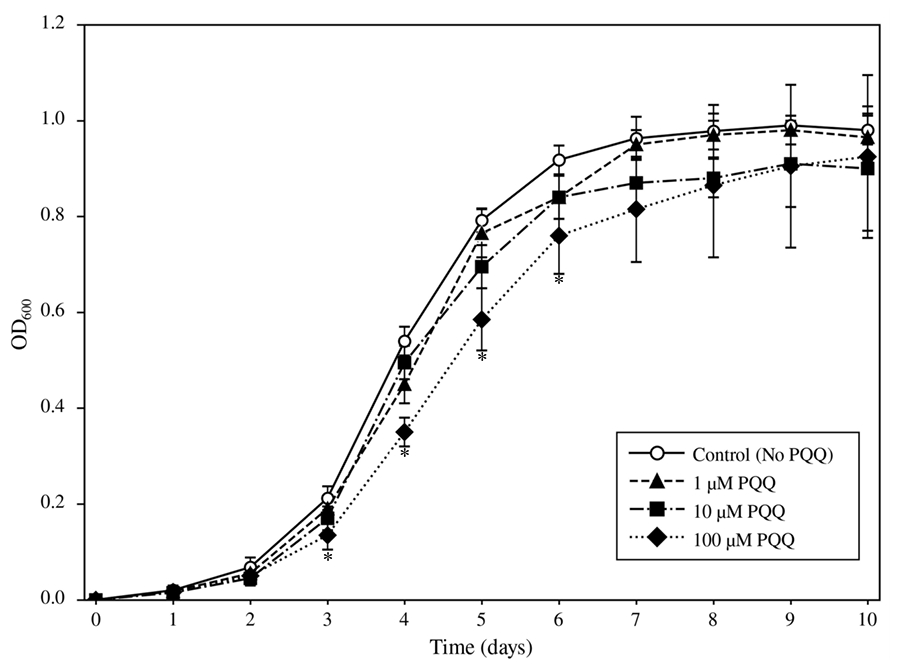
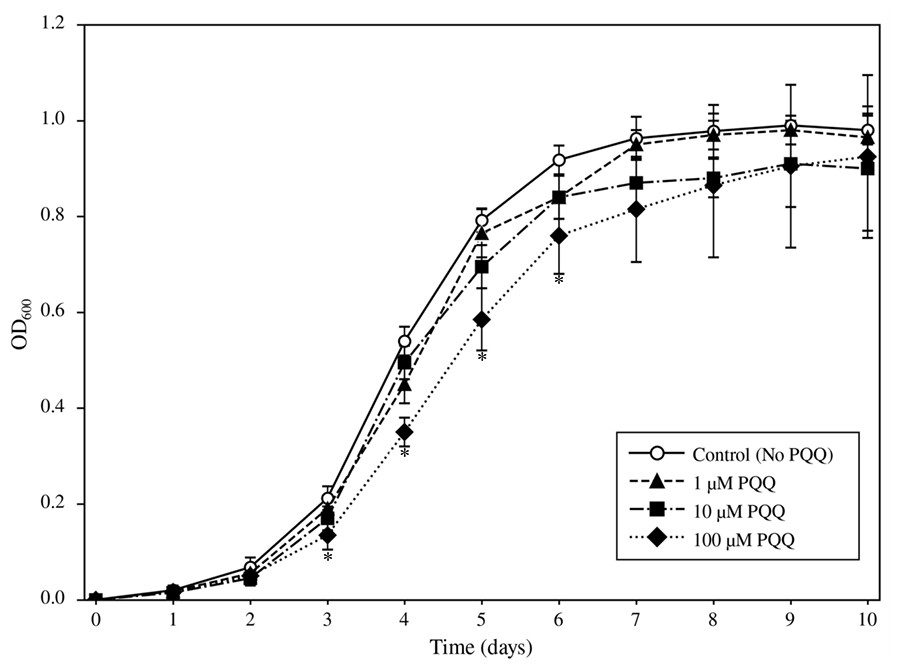
PQQ serves as a redox cofactor for several bacterial dehydrogenases (Duine et al., 1979; Naveed, 2016) and has been associated with solubilization of inorganic phosphate through the production of organic acids and subsequent acidification of the surrounding environments (An and Moe, 2016). Therefore, we examined whether exogenous PQQ affected the growth and phosphate-solubilizing activity of B. diazoefficiens USDA110. Additionally, growth curve studies were conducted to determine an appropriate concentration of exogenous PQQ for subsequent experiments. The effect of exogenous PQQ was evaluated by culturing the bacterium in BMM supplemented with 0, 1, 10, or 100 µM PQQ. Cultures supplemented with 1 or 10 µM PQQ exhibited growth patterns comparable to that of the control without PQQ, indicating no apparent growth defect during the exponential growth phase (Fig. 1). In contrast, supplementation with 100 µM PQQ resulted in slower growth during the exponential phase and lower maximum OD600 values during the stationary phase, which suggests that the relatively high concentration of PQQ may adversely affect bacterial growth (Fig. 1). Therefore, 10 µM PQQ was selected for further investigation because it did not cause an apparent reduction in the bacterial growth rate, particularly during the exponential phase.
Phosphate availability influences the bacterial growth response to exogenous PQQ
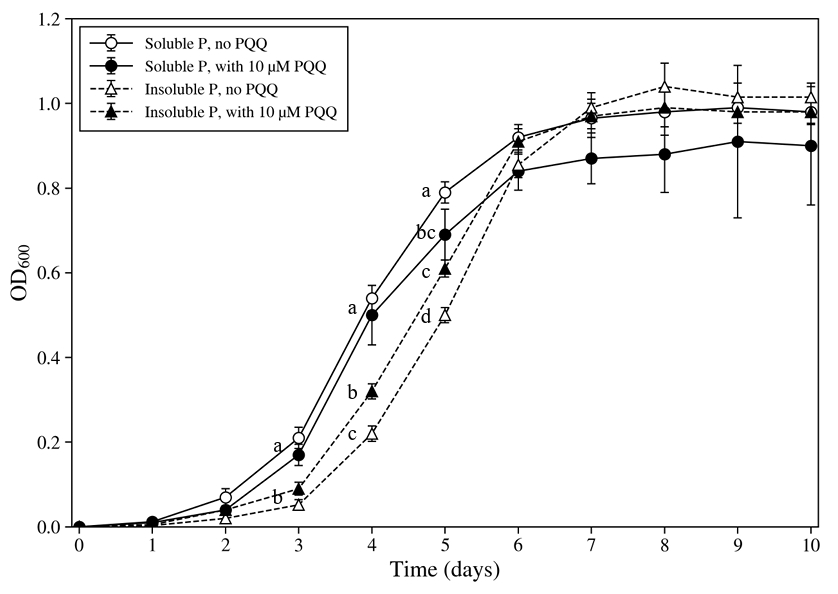
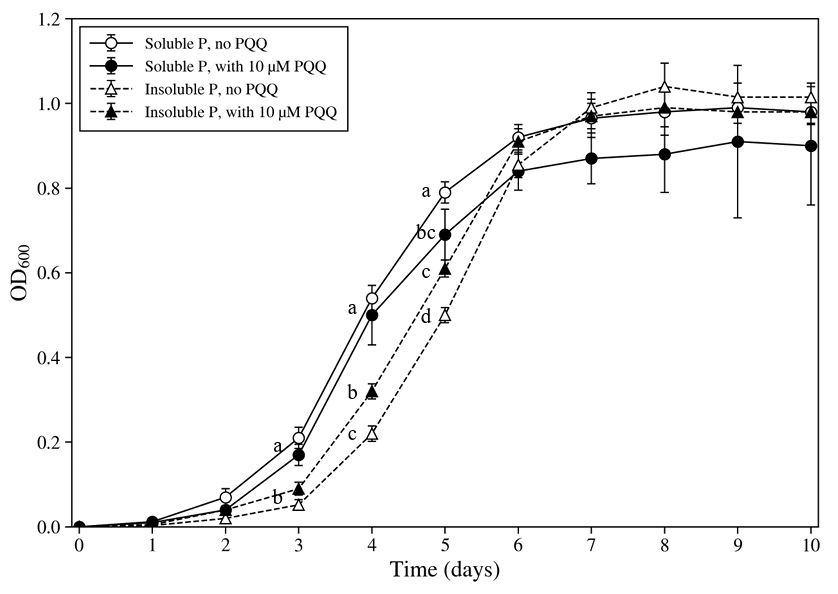
Using the 10 µM exogenous PQQ concentration selected in the preceding experiment, bacterial growth was further examined under soluble- and insoluble-phosphate conditions (Fig. 2). The bacterium was grown either in standard BMM or soluble phosphate-omitted BMM, in which K2HPO4 and KH2PO4 were replaced with insoluble tricalcium phosphate [Ca₃(PO₄)₂] as the sole P source. Under soluble-phosphate conditions, as also shown in Fig. 1, PQQ supplementation resulted in moderately lower O.D. values during the stationary phase, whereas no significant difference from the untreated control was observed during the exponential phase. These results indicate that PQQ did not accelerate bacterial growth when soluble phosphate was readily available. In contrast, under insoluble-phosphate conditions, PQQ supplementation increased cell density during the early and middle stages of growth, particularly between days 3 and 6 (Fig. 2). After 7 days, however, cultures with and without PQQ reached similar O.D. values. Thus, 10 µM PQQ enhanced early bacterial growth when bioavailable P was limited, but did not increase the final culture density.
Solubilization of tricalcium phosphate is associated with culture acidification
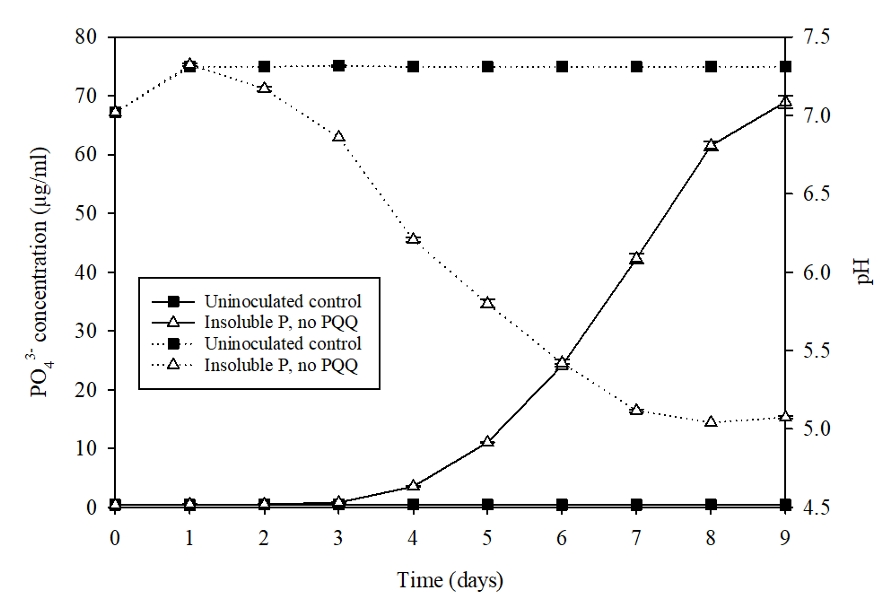
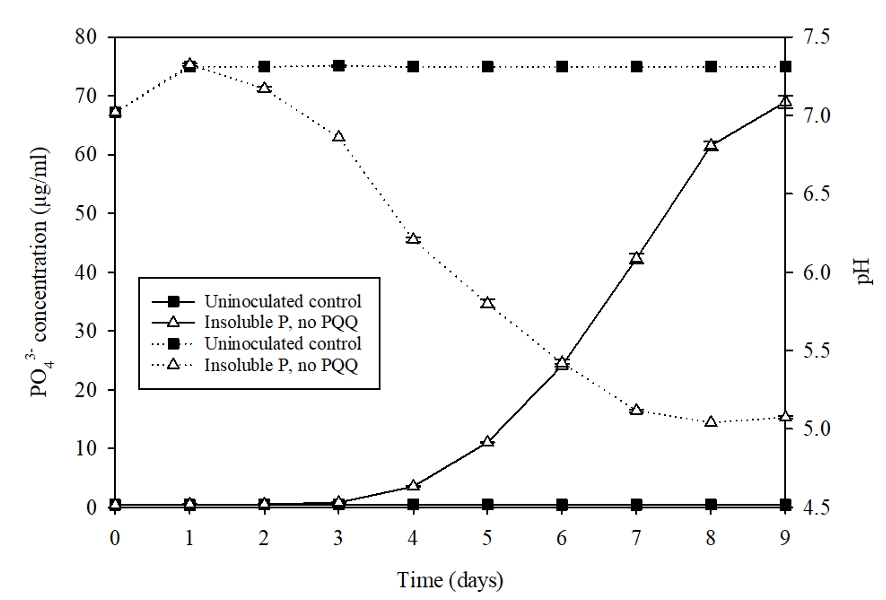
Before evaluating the effect of exogenous PQQ on P solubilization, the intrinsic ability of B. diazoefficiens USDA110 to solubilize inorganic phosphate was examined. The bacterium was grown in BMM containing insoluble tricalcium phosphate [Ca₃(PO₄)₂] as the sole P source. Dissolved phosphate concentrations in the culture supernatant and culture pH were monitored over 9 days (Fig. 3).
The initial dissolved phosphate concentration in the inoculated culture was 0.43 µg/ml and remained low during the first 3 days. Then, the concentration subsequently increased, reaching a maximum of 69.5 ± 3.2 µg/ml on day 9 (Fig. 3). In contrast, dissolved phosphate remained near zero in the uninoculated control throughout the experiment. The increase in dissolved phosphate in the inoculated culture was accompanied by a gradual decrease in pH, from approximately 7.0 at inoculation to 5.0 by days 8 and 9. However, the pH of the uninoculated control remained stable at neutral pH throughout the experiment (Fig. 3). The inverse temporal pattern between dissolved phosphate concentrations and culture pH indicates that phosphate solubilization by B. diazoefficiens USDA110 was associated with acidification of the culture medium.
Exogenous PQQ enhances phosphate solubilization
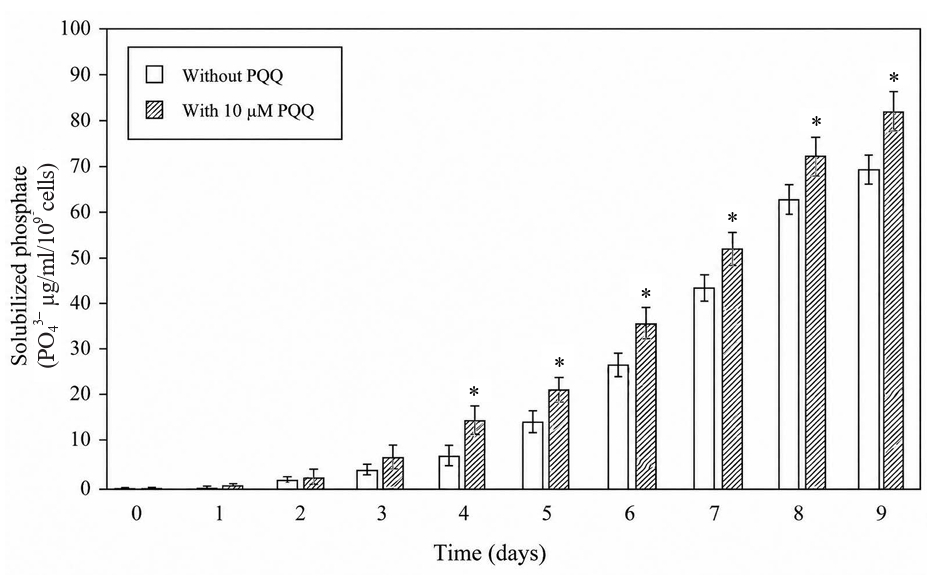
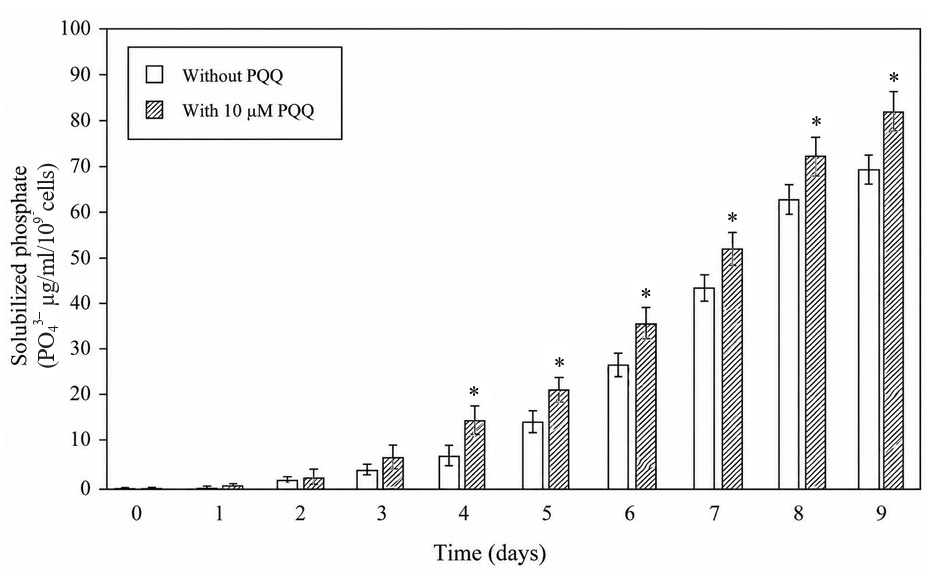
The effect of 10 µM PQQ on phosphate solubilization by B. diazoefficiens USDA110 was evaluated in cultures containing tricalcium phosphate [Ca₃(PO₄)₂] as the sole P source. Cell-normalized phosphate concentrations increased significantly over time in both cultures with or without exogenous PQQ (Fig. 4). However, from days 4 through 9, cultures supplemented with 10 µM PQQ contained significantly higher concentrations of dissolved phosphate than those without PQQ (P < 0.05). These results indicate that PQQ accelerated phosphate solubilization beginning during the metabolically active phase of growth. By day 9, phosphate solubilization reached 81.8 ± 4.3 µg/ml per 10⁹ cells in cultures with 10 µM PQQ. No dissolved phosphate was detected in the uninoculated control at any sampling point (Fig. 4). Collectively, these results demonstrate that exogenous PQQ primarily enhanced phosphate solubilization in the given experimental period.
Effects of carbon source and phosphate availability on extracellular PQQ accumulation
Since exogenous PQQ increased phosphate solubilization, we examined endogenous levels of extracellular PQQ under different carbon-source and phosphate conditions. Extracellular PQQ concentrations were compared between cultures grown with glycerol or glucose as the sole carbon source under soluble- or insoluble-phosphate conditions. To quantify PQQ in cell-free culture supernatants, commercially obtained holo-GDH was converted to its inactive apo form by dialysis to remove enzyme-bound PQQ. The activities of holo-GDH and apo-GDH were 0.146 and 0.002 U/ml, respectively, confirming that PQQ removal almost completely abolished GDH activity (98.6% reduction). Apo-GDH was then reconstituted with known concentrations of PQQ, and the restored enzyme activity was used to generate a PQQ standard curve. Using the standard curve, PQQ concentrations in culture supernatants were quantified by measuring the GDH activity restored following incubation of apo-GDH with culture supernatants.
Under insoluble-phosphate conditions, PQQ concentrations were not significantly different between glycerol- and glucose-grown cultures (Table 2). This result was unexpected because greater PQQ accumulation was anticipated in glucose-grown cultures under bioavailable P-limited conditions, in which PQQ may serve as a cofactor for GDH and facilitate phosphate solubilization. Moreover, under soluble-phosphate conditions, PQQ concentrations varied with the carbon source, with the highest concentration detected in glycerol-grown cultures and the lowest in glucose-grown cultures (Table 2). Unlike the findings reported for P. putida by An and Moe (2016), these results suggest that extracellular PQQ accumulation in B. diazoefficiens USDA110 is not regulated solely by its role as a GDH cofactor in phosphate solubilization. Instead, it may be associated with overall cellular metabolic activity or other physiological functions. However, since we have employed the apo-GDH reconstitution assay that quantifies extracellular PQQ rather than endogenous GDH activity, further investigation is required to test this hypothesis.
Expression of genes involved in PQQ biosynthesis under different phosphate conditions
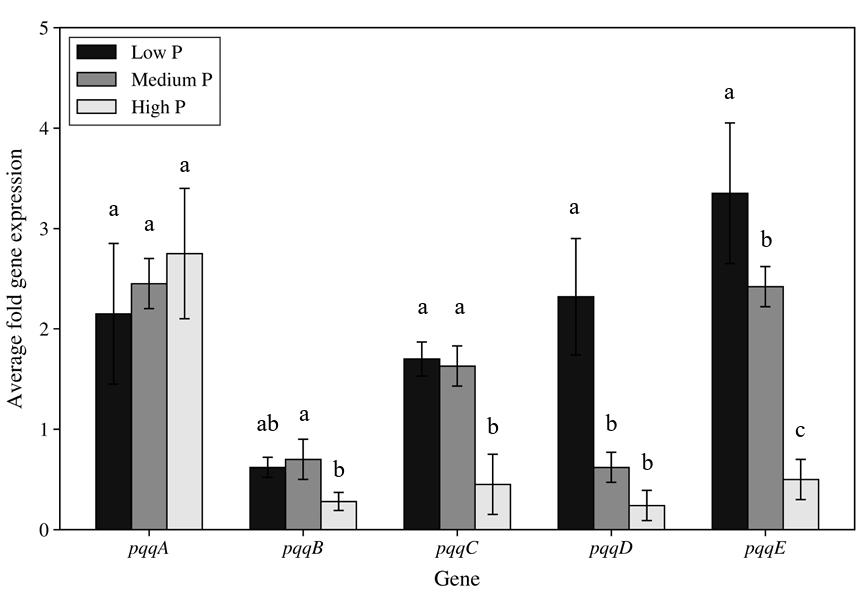
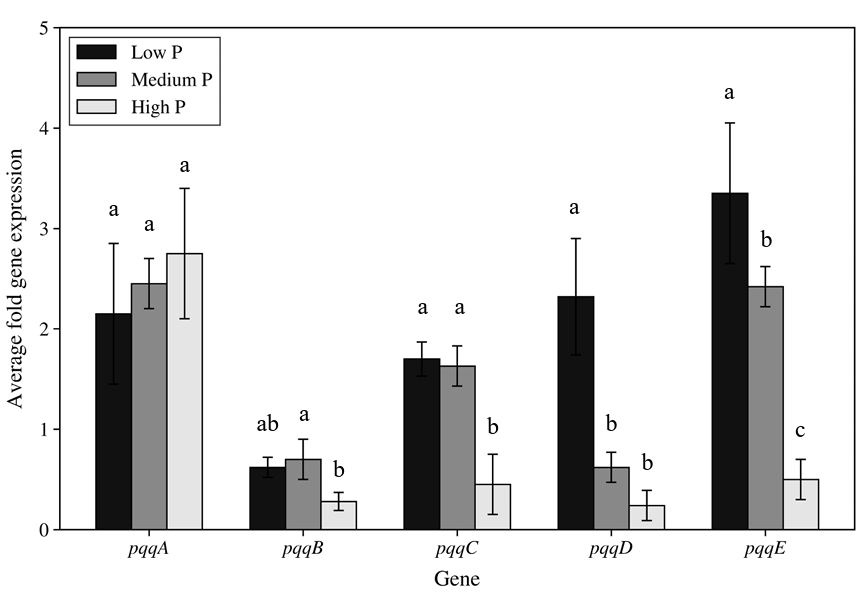
Since extracellular PQQ production varied with phosphate availability, the expression of genes (pqqA-E) involved in PQQ biosynthesis was examined in exponential-phase cultures of B. diazoefficiens USDA110 grown with glucose under low-, medium-, and high-phosphate conditions. Overall, the pqq genes were more strongly expressed under low- and medium-phosphate conditions than high-phosphate conditions (Fig. 5). In particular, pqqB, pqqC, pqqD, and pqqE showed lower expression under the high-phosphate condition than under low- or medium-phosphate conditions, although significant differences were observed for pqqC, pqqD, and pqqE. However, pqqA remained highly expressed across all phosphate concentrations and was not suppressed by high phosphate, suggesting that phosphate-dependent regulation of PQQ biosynthesis may occur downstream of pqqA, potentially through differential regulation of pqqB–E.
These expression patterns indicate that high bioavailable phosphate generally suppresses most genes involved in PQQ biosynthesis. This result is consistent with the greater extracellular PQQ concentration previously detected in glucose-grown cultures under insoluble-phosphate conditions than under soluble-phosphate conditions (Table 2), supporting a relationship between limited bioavailable phosphate and increased PQQ production.
Transcriptomic response of B. diazoefficiens USDA110 to exogenous PQQ
RNA-seq was performed to characterize global transcriptional changes of B. diazoefficiens USDA110 in response to exogenous 10 µM PQQ. Among the significantly upregulated genes, many encoded hypothetical or uncharacterized proteins (Table S1). The most strongly upregulated annotated genes included blr7475, encoding phage holin family protein (3.09-fold); bll2752, encoding a glycosyltransferase family 4 protein (2.99-fold); blr1496, encoding a CsbD-family protein (2.45-fold); and blr4936, encoding a putative cation-efflux system protein (2.42-fold). Several genes encoding two-component response regulators were also moderately upregulated.
PQQ supplementation decreased the expression of a greater number of annotated genes in USDA110 (Table S2). Included are bll3998, encoding a probable NADP⁺-dependent succinate-semialdehyde dehydrogenase; blr1289, encoding oleate hydratase; bll6069, encoding a universal stress protein; bll5655, encoding alcohol dehydrogenase AdhP; and blr2611, encoding a helix–turn–helix domain-containing protein. Genes involved in microaerobic respiration and nitrogen fixation, including fixG, fixK, fixN, and fixO, were also downregulated, suggesting that exogenous PQQ suppressed activation of the low-oxygen respiratory machinery required to support nitrogenase activity.
Notably, genes annotated as glucose dehydrogenase (GDH) or glycerol dehydrogenase (GlyDH) were not identified among the differentially expressed genes following PQQ supplementation, although several other dehydrogenase-encoding genes were downregulated, including those encoding succinate-semialdehyde dehydrogenase, alcohol dehydrogenase AdhP, and an uncharacterized putative dehydrogenase. Therefore, the transcriptional response to exogenous PQQ does not provide strong evidence that the observed PQQ-enhanced phosphate solubilization was associated with increased transcription of GDH- or GlyDH-encoding genes.
Rhizobia, including many Bradyrhizobium species, are agriculturally important bacteria that can improve plant nitrogen nutrition by establishing symbiotic, nitrogen-fixing relationships with leguminous plants. Some strains can also solubilize inorganic phosphate, although this ability varies among strains (Antoun et al., 1998; Halder and Chakrabartty, 1993). B. diazoefficiens, formerly classified as B. japonicum, was previously described as a non-phosphate-solubilizing bacterium (Fernández et al., 2005); however, its ability to solubilize tricalcium phosphate [Ca₃(PO₄)₂] and rock phosphate has also been reported (López-Ortega et al., 2013). In the present study, B. diazoefficiens USDA110 solubilized Ca₃(PO₄)₂, increasing the dissolved phosphate concentration up to 69.5 ± 3.2 µg/ml as the culture pH declined from approximately 7.0 to 5.0. This inverse relationship demonstrates that phosphate solubilization by the bacterium was closely associated with acidification of the culture medium, consistent with pH changes previously reported for B. diazoefficiens USDA110 grown with Ca₃(PO₄)₂ (López-Ortega et al., 2013). Furthermore, exogenous PQQ further enhanced phosphate solubilization when bioavailable phosphate was limited.
PQQ is a redox cofactor for several bacterial dehydrogenases involved in carbon oxidation and energy metabolism (Duine et al., 1979; Ferri et al., 2011; Naveed, 2016). Exogenous 10 µM PQQ increased cell-normalized dissolved phosphate concentrations from days 4 through 9 and temporarily enhanced bacterial growth when Ca₃(PO₄)₂ was the sole P source. However, PQQ did not promote growth when soluble phosphate was available, and a high PQQ concentration (e.g., 100 µM) inhibited bacterial growth. Hence, PQQ primarily accelerated phosphate mobilization under P-limited conditions rather than functioning as a growth stimulant. The inhibitory effect of the higher PQQ concentration is consistent with previous evidence that the bacterial response to PQQ is concentration and strain dependent (Ameyama et al., 1984).
In many phosphate-solubilizing bacteria, PQQ-dependent glucose dehydrogenase (GDH) oxidizes glucose to gluconate or gluconic acid, producing an acidic environment that facilitates mineral-phosphate dissolution (An and Moe, 2016). Rhizobia can subsequently metabolize gluconate through the Entner–Doudoroff and ketogluconate pathways (Keele et al., 1970; Stowers, 1985; Stowers and Elkan, 1984). The presence and activity of a PQQ–GDH system, however, vary among bacterial species and strains. Some bacteria, including E. coli, R. leguminosarum, and S. meliloti, possess apo-GDH but produce insufficient PQQ to form the active holoenzyme unless exogenous PQQ is supplied (Bernardelli et al., 2001; Boiardi et al., 1996; Hommes et al., 1985). PQQ-linked GDH activity has been reported in B. diazoefficiens, although gluconate may not accumulate because it can be rapidly metabolized after production (Boiardi et al., 1996). Despite this proposed mechanism, the current findings do not support a close association between extracellular PQQ production and native GDH activity in B. diazoefficiens USDA110. Under insoluble-phosphate conditions, extracellular PQQ concentrations were not significantly different between glucose- and glycerol-grown cultures. Furthermore, under soluble-phosphate conditions, the extracellular PQQ concentration was higher in glycerol-grown cultures than in glucose-grown cultures. This finding is different from that of P. putida KT2440, in which glucose and phosphate limitation promote PQQ production and GDH activity (An and Moe, 2016). Therefore, PQQ production by B. diazoefficiens is unlikely to be regulated by the requirement for GDH-mediated glucose oxidation. Instead, the bacterium may regulate PQQ biosynthesis independently of GDH expression, allowing the cofactor to activate other preexisting enzymes at the post-translational level or to be released into the extracellular environment in response to changes in cellular physiology.
The apo-GDH reconstitution assay was selected to quantify extracellular PQQ because it provides a sensitive, cost-effective, and relatively easy method requiring minimal sample preparation. Unlike LC–MS/MS, it does not require extensive extraction, purification, or concentration procedures that may introduce analyte loss or variability. Moreover, by measuring concentrations of extracellular PQQ to restore the activity of apo-GDH, the assay provides a biologically relevant estimate of functionally available PQQ. However, an important limitation is that it quantifies extracellular PQQ rather than endogenous GDH activity in B. diazoefficiens USDA110. Consequently, neither higher extracellular PQQ concentrations can be interpreted as evidence of greater native GDH activity, nor can lower concentrations be assumed to reflect increased PQQ utilization by GDH. Nevertheless, the carbon-source-dependent pattern suggests that extracellular PQQ production may be associated with other dehydrogenases, redox metabolism, or additional cellular functions unrelated to GDH-mediated phosphate solubilization.
The RNA-seq results further indicate that PQQ-enhanced phosphate solubilization was not associated with increased GDH expression. Genes annotated as GDH or glycerol dehydrogenase were not differentially expressed following PQQ supplementation. However, the absence of transcriptional induction does not exclude their involvement because PQQ may enhance the activity of pre-existing enzymes without increasing their transcription. Instead, PQQ altered the expression of genes associated with cell-envelope modification, stress responses, two-component regulation, and ion transport (Tables S1 and S2). Notably, bll2752, encoding a glycosyltransferase family 4 protein, and blr4936, encoding a putative cation-efflux system protein, were upregulated, whereas several other dehydrogenase genes were downregulated. These findings suggest that exogenous PQQ elicited a broader physiological response rather than selectively inducing a conventional PQQ–GDH pathway. However, RNA-seq data provide a snapshot of gene expression at a single sampling point; therefore, although samples were collected during the metabolically active mid-exponential phase, earlier or transient changes in the expression of genes involved in the PQQ–GDH pathway may have been missed.
Interestingly, one potential mechanism by which PQQ may enhance phosphate solubilization independently of GDH-mediated glucose oxidation is through alterations in membrane-associated ion transport and proton homeostasis, thereby creating a more acidic microenvironment around the cells. Increased proton release could promote Ca₃(PO₄)₂ dissolution by protonating phosphate species and weakening their association with Ca²⁺. Consistent with this possibility, blr4936, encoding a putative cation-efflux system protein, was upregulated, while induction of a glycosyltransferase may indicate changes in the cell envelope that affect ion exchange or cell–mineral interactions. In addition to these processes, other organic acid production pathways may contribute to medium acidification. For example, tricarboxylic acid cycle intermediates such as citrate, succinate, and malate could promote phosphate release through extracellular acidification and Ca²⁺ chelation. PQQ may facilitate this process through other dehydrogenases that alter carbon flux. However, membrane-associated ion transport, proton release, organic acid production, and the activities of alternative dehydrogenases were not directly measured in this study. Therefore, these proposed mechanisms remain hypothetical. The specific organic acids present in the culture supernatants should be identified in future studies.
Expression of the PQQ biosynthesis genes indicated that PQQ metabolism responded to phosphate availability. In general, pqqB, pqqC, pqqD, and pqqE were expressed at lower levels under high-phosphate conditions, whereas pqqA remained highly expressed across all phosphate concentrations (Fig. 5). This expression pattern suggests that phosphate-dependent regulation may occur primarily at the PQQ-processing and maturation steps downstream of pqqA, rather than through regulation of the precursor itself. PQQ quantification showed that extracellular PQQ concentrations were higher in glucose-grown cultures under insoluble-phosphate conditions than under soluble-phosphate conditions, which is consistent with this gene-expression pattern (Fig. 5, Table 2). However, a similar phosphate-dependent pattern of extracellular PQQ accumulation was not observed in glycerol-grown cultures. This discrepancy suggests that pqq gene transcription and extracellular PQQ accumulation may not be directly coupled. PQQ biosynthesis may be regulated independently of its secretion, cellular retention, utilization, or degradation, and post-transcriptional regulation may further influence PQQ production depending on carbon metabolism and phosphate availability. These possibilities were not directly examined and require further investigation.
Interestingly, exogenous PQQ also downregulated fixG, fixK, fixN, and fixO, which contribute to the regulatory and respiratory responses required under microaerobic conditions. FixK regulates genes involved in low-oxygen metabolism, whereas FixG contributes to the assembly and function of the associated respiratory system. FixN and FixO are components of the high-affinity cbb₃-type cytochrome c oxidase, which supports respiration under the low-oxygen conditions required for nitrogenase activity. However, it would be premature to conclude that exogenous PQQ suppresses biological nitrogen fixation because the RNA-seq analysis was conducted in aerobic, free-living cultures rather than in the microaerobic environment of soybean nodules. The biological significance of these transcriptional changes should be evaluated under symbiotic conditions by examining the expression of both fix and nif genes in nodules and measuring nodulation, nitrogenase activity, and plant nitrogen accumulation.
Collectively, these findings demonstrate that B. diazoefficiens USDA110 solubilizes Ca₃(PO₄)₂ through an acidification-associated process that is enhanced by PQQ. However, extracellular PQQ measurements and RNA-seq analysis do not establish the molecular mechanism responsible for this enhancement. Although genes annotated as glucose or glycerol dehydrogenases were not transcriptionally induced, their involvement cannot be excluded because PQQ may activate pre-existing enzymes without increasing their transcription. Other PQQ-dependent enzymes, GDH-independent organic acid production, proton release, or changes in membrane-associated ion transport may also contribute to the observed enhancement, but these processes were not directly measured in this study. Therefore, direct measurements of proton release, organic acid production, and native GDH activity following PQQ supplementation will be necessary to distinguish among these potential mechanisms in future studies.
From an agricultural perspective, the combined nitrogen-fixing and phosphate-solubilizing capacities of B. diazoefficiens USDA110 suggest its potential as a dual-function bioinoculant for improving nitrogen and phosphorus availability in P-deficient soils. However, these findings should be validated under field conditions before the development of an effective and reliable biofertilizer. Future studies should evaluate symbiotic nitrogen fixation, nodulation, plant nitrogen and phosphorus acquisition, growth, and yield of soybean cultivated in soils with low phosphorus availability. Demonstrating improvements in crop performance and yield will be essential for establishing the agronomic and economic value of this approach for the agricultural industry.
The online version contains supplementary material available at https://doi.org/10.71150/jm.2608023
Table S1.
List of genes up-regulated (> 2-fold cut-off) in response to 10 μM PQQ
jm-2608023-Supplementary-Table-S1.pdf
Table S2.
List of genes down-regulated (< -2-fold cut-off) in response to 10 μM PQQ
jm-2608023-Supplementary-Table-S2.pdf
Table S3.
Estimated cell densities of B. diazoefficiens USDA110 grown under insoluble-phosphate conditions with or without 10 μM PQQ
jm-2608023-Supplementary-Table-S3.pdf
Fig. S1.
Effect of exogenous PQQ on unnormalized dissolved phosphate concentrations in cultures of B. diazoefficiens USDA110. The bacterium was grown in BMM containing insoluble tricalcium phosphate [Ca₃(PO₄)₂] as the sole P source, with or without 10 μM exogenous PQQ. Dissolved phosphate (PO4³⁻) concentrations in the culture supernatant were measured over 9 days and are presented without normalization to cell mass. Bars represent the means of three biological replicates, and error bars indicate the standard error of the Mean. Asterisks indicate significant differences between cultures with and without PQQ at the corresponding time points, as determined using two-tailed unpaired Student’s t-tests (P < 0.05). Comparisons were not made across time points.
jm-2608023-Supplementary-Fig-S1.pdf
Fig. 1.
Effect of PQQ concentrations on the growth of B. diazoefficiens USDA110. Growth of B. diazoefficiens USDA110 was examined in BMM supplemented with 0.4% glycerol as the sole carbon source and different concentrations of PQQ. Bacterial growth was monitored by measuring optical density at 600 nm (OD600). Values represent the mean of three biological replicates, and error bars indicate the standard error of the mean. At each time point, the PQQ-treated groups were compared with the no-PQQ control using one-way ANOVA followed by Dunnett’s post hoc test. Asterisks indicate significant differences between the 100 µM PQQ treatment and the control at the corresponding time point (P < 0.05). Comparisons were not made across time points. ○, control without PQQ; ▲, 1 µM PQQ; ■, 10 µM PQQ; ◆, 100 µM PQQ.
jm-2608023f1.jpg
Fig. 2.
Effect of exogenous PQQ on bacterial growth under soluble- and insoluble-phosphate conditions. B. diazoefficiens USDA110 was grown in BMM supplemented with 0.4% glycerol with or without 10 µM exogenous PQQ. Soluble phosphate was provided as KH2PO4 and K2HPO4 in standard BMM, whereas tricalcium phosphate [Ca₃(PO₄)₂] was provided as the sole P source for insoluble-phosphate conditions. Bacterial growth was monitored over 10 days by measuring the optical density at 600 nm (OD600). Values represent the mean of three biological replicates, and error bars indicate the standard error of the mean. The four treatments were compared separately at each time point using one-way ANOVA followed by Tukey’s post hoc test. Statistical comparisons are shown for the exponential growth phase. Different letters indicate significant differences among treatments at the same time point, whereas treatments sharing the same letter are not significantly different (P < 0.05). The absence of letters indicates no significant differences at that time point. Comparisons were not made across time points. ○, soluble phosphate without PQQ; ●, soluble phosphate with 10 µM PQQ; △, insoluble phosphate without PQQ; and ▲, insoluble phosphate with 10 µM PQQ.
jm-2608023f2.jpg
Fig. 3.
Phosphate solubilization and pH changes in B. diazoefficiens USDA110 cultures. B. diazoefficiens USDA110 was grown in BMM containing insoluble tricalcium phosphate [Ca₃(PO₄)₂] as the sole P source without PQQ. Dissolved phosphate (PO4³⁻) concentrations and culture pH were measured over 9 days. Solid lines represent dissolved phosphate concentrations plotted on the left y-axis, and dotted lines represent pH values plotted on the right y-axis. Each time point represents the mean of three biological replicates, and error bars indicate the standard error of the mean. ■, uninoculated control; △, the bacterium culture containing insoluble phosphate.
jm-2608023f3.jpg
Fig. 4.
Effect of exogenous PQQ on phosphate solubilization by B. diazoefficiens USDA110. The bacterium was grown in BMM containing insoluble tricalcium phosphate [Ca₃(PO₄)₂] as the sole P source, with or without 10 µM exogenous PQQ. Solubilized phosphate (PO4³⁻) in the culture supernatant was measured over 9 days and normalized to 1 × 10⁹ cells. Cell abundance was estimated using OD₆₀₀ as a proxy, based on the relationship that OD₆₀₀ values of 1.0 and 0.1 corresponded to 1 × 10⁹ and 1 × 10⁸ CFU/ml, respectively. This approximate conversion was applied uniformly to both treatments at all time points (Table S3); therefore, the cell-normalized values should be interpreted as estimates. The corresponding unnormalized values are presented in Fig. S1. Bars represent the Mean of three biological replicates, and error bars indicate the standard error of the mean. Asterisks indicate statistically significant differences between cultures with and without PQQ at the indicated time points (Student’s t-test, P < 0.05).
jm-2608023f4.jpg
Fig. 5.
Expression of pqq genes in B. diazoefficiens USDA110 under different phosphate concentrations. The relative expression levels of pqqA, pqqB, pqqC, pqqD, and pqqE genes were determined in B. diazoefficiens USDA110 grown in BMM supplemented with 0.4% glucose as the sole carbon source. Average fold changes were calculated from gene expression values that were normalized to the house keeping gene parA. Cultures were grown under low-, medium-, and high-phosphate conditions containing 1, 4.5, and 10 mM soluble phosphate, respectively. The medium-phosphate condition corresponded to the phosphate concentration in standard BMM. Bars represent the mean relative gene expression levels from three biological replicates, and error bars indicate the standard error of the mean. For each gene, differences among low-, medium-, and high-phosphate treatments were analyzed using one-way ANOVA followed by Tukey’s post hoc test. Different letters indicate significant differences among phosphate treatments within the same gene (P < 0.05), but not among different genes.
jm-2608023f5.jpg
Table 1.
List of qPCR primers used in this study
Gene Sequence (5′–3′) Length Melting temp (°C) GC%
parA (bll0631) F TCAACCTTCTGACGGTGAACGC 22 60 54.5
parA (bll0631) R TGCAGCAATTGCGACAGACCTT 22 60 50
pqqA (bsr6735) F AGCCAAATGGCCTGGAAA 18 62 50
pqqA (bsr6735) R GGTGGCGCTCACATACAT 18 62 55.6
pqqB (blr6736) F AATCGAGGTGTTGCCGTT 18 62 50
pqqB (blr6736) R GTCGTCTTGTCGGTGATCTT 20 62 50
pqqC (blr6737) F CGATCGGCAAGGACATCAA 19 62 52.6
pqqC (blr6737) R CGGATGCAGGCTGTGATAG 19 62 57.9
pqqD (blr6738) F GGCATGCCAAGCTGAAATAC 20 62 50
pqqD (blr6738) R GTTGCAGAGCTGCAGGA 17 62 58.8
pqqE (blr6739) F CCGCTGCAATGTCCCTATT 19 62 52.6
pqqE (blr6739) R GCTCGCTCAACACCTTCTT 19 62 52.6
Table 2.
PQQ production of B. diazoefficiens USDA110 grown on different carbon and phosphorus sources#
PQQ concentration (nM) Insoluble P Soluble P
Glycerol Glucose Glycerol Glucose
10.48 ± 1.06a 9.84 ± 0.73a 14.47 ± 0.88b 6.57 ± 1.42c

#Bacterial cultures were grown with either glycerol or glucose as the sole carbon source under soluble- or insoluble-phosphate conditions. Cell-free supernatants were collected when the cultures reached an OD600 of 0.5. Extracellular PQQ concentrations were converted from ng/ml to nM using the molecular weight of PQQ free acid (330.21 g/mol). Values represent the Mean ± standard error from three biological replicates. PQQ concentrations among the four experimental conditions were analyzed using one-way ANOVA followed by Tukey’s post hoc test. Values followed by different letters are significantly different among growth conditions (P < 0.05).

  • Abd-Alla MH. 1994. Solubilization of rock phosphates by Rhizobium and Bradyrhizobium. Folia Microbiol (Praha). 39: 53–56. ArticlePDF
  • Ameyama M, Shinagawa E, Matsushita K, Adachi O. 1984. Growth stimulation of microorganisms by pyrroloquinoline quinone. Agric Biol Chem. 48: 2909–2911. Article
  • An R, Moe LA. 2016. Regulation of pyrroloquinoline quinone-dependent glucose dehydrogenase activity in the model rhizosphere-dwelling bacterium Pseudomonas putida KT2440. Appl Environ Microbiol. 82: 4955–4964. ArticlePubMedPMCLink
  • Antoun H, Beauchamp CJ, Goussard N, Chabot R, Lalande R. 1998. Potential of Rhizobium and Bradyrhizobium species as plant growth promoting rhizobacteria on non-legumes: Effect on radishes (Raphanus sativus L.). Plant Soil. 204: 57–67. ArticlePDF
  • Babalola OO, Glick BR. 2012. The use of microbial inoculants in African agriculture: Current practice and future prospects. J Food Agric Environ. 10: 540–549. Link
  • Bergersen FJ. 1961. The growth of Rhizobium in synthetic media. Aust J Biol Sci. 14: 349–360. ArticlePDF
  • Bernardelli CE, Luna MF, Galar ML, Boiardi JL. 2001. Periplasmic PQQ-dependent glucose oxidation in free-living and symbiotic rhizobia. Curr Microbiol. 42: 310–315. ArticlePubMedPDF
  • Bittner M, Butow R, DeRisi J, Diehn M, Eberwine J, et al. 2003. Expression analysis of RNA. In Bowtell D, Sambrook J. (eds.), DNA microarrays: A molecular cloning manual, pp. 101–288. Cold Spring Harbor Laboratory Press. Link
  • Boiardi J, Galar ML, Neijssel OM. 1996. PQQ-linked extracellular glucose oxidation and chemotaxis towards this cofactor in rhizobia. FEMS Microbiol Lett. 140: 179–184. Article
  • Chen PS, Toribara TY, Warner H. 1956. Microdetermination of phosphorus. Anal Chem. 28: 1756–1758. Article
  • Cleton-Jansen AM, Goosen N, Fayet O, van de Putte P. 1990. Cloning, mapping, and sequencing of the gene encoding Escherichia coli quinoprotein glucose dehydrogenase. J Bacteriol. 172: 6308–6315. ArticlePubMedPMCLink
  • Cytryn EJ, Sangurdekar DP, Streeter JG, Franck WL, Chang WS, et al. 2007. Transcriptional and physiological responses of Bradyrhizobium japonicum to desiccation-induced stress. J Bacteriol. 189: 6751–6762. ArticlePubMedPMCLink
  • Dawadi P, Pokharel B, Shrestha A, Niraula D, Naeem A, et al. 2025. From bench to bytes: A practical guide to RNA sequencing data analysis. Front Genet. 16: 1697922.ArticlePubMedPMC
  • Duine JA, Frank Jzn J, Van Zeeland JK. 1979. Glucose dehydrogenase from Acinetobacter calcoaceticus. FEBS Lett. 108: 443–446. ArticlePubMedLink
  • Dunnett CW. 1955. A multiple comparison procedure for comparing several treatments with a control. J Am Stat Assoc. 50: 1096–1121. Article
  • Fernández LA, Zalba P, Gómez MA, Sagardoy MA. 2005. Phosphate inorganic solubilizing bacteria isolated from soybean region soils. Cienc Suelo. 23: 31–37. PDF
  • Ferri S, Kojima K, Sode K. 2011. Review of glucose oxidases and glucose dehydrogenases: A bird’s eye view of glucose sensing enzymes. J Diabetes Sci Technol. 5: 1068–1076. ArticlePubMedPMCLink
  • Goldstein AH. 1995. Recent progress in understanding the molecular genetics and biochemistry of calcium phosphate solubilization by Gram-negative bacteria. Biol Agric Hortic. 12: 185–193. Article
  • Halder AK, Chakrabartty PK. 1993. Solubilization of inorganic phosphate by Rhizobium. Folia Microbiol. 38: 325–330. ArticlePDF
  • Hommes RWJ, van Hell B, Postma PW, Neijssel OM, Tempest DW. 1985. The functional significance of glucose dehydrogenase in Klebsiella aerogenes. Arch Microbiol. 143: 163–168. ArticlePubMedPDF
  • Isidra-Arellano MC, Reyero-Saavedra MDR, Sánchez-Correa MDS, Pingault L, Sen S, et al. 2018. Phosphate deficiency negatively affects early steps of the symbiosis between common bean and rhizobia. Genes. 9: 498.ArticlePubMedPMC
  • Jeon JM, Lee HI, Donati AJ, So JS, Emerich DW, et al. 2011. Whole-genome expression profiling of Bradyrhizobium japonicum in response to hydrogen peroxide. Mol Plant Microbe Interact. 24: 1472–1481. ArticlePubMed
  • Kalayu G. 2019. Phosphate solubilizing microorganisms: Promising approach as biofertilizers. Int J Agron. 2019: 4917256.ArticlePDF
  • Kato C, Kawai E, Shimizu N, Mikekado T, Kimura F, et al. 2018. Determination of pyrroloquinoline quinone by enzymatic and LC-MS/MS methods to clarify its levels in foods. PLoS One. 13: e0209700. ArticlePubMedPMC
  • Keele BB, Hamilton PB, Elkan GH. 1970. Gluconate catabolism in Rhizobium japonicum. J Bacteriol. 101: 698–704. ArticleLink
  • Khairnar NP, Misra HS, Apte SK. 2003. Pyrroloquinoline-quinone synthesized in Escherichia coli by pyrroloquinoline-quinone synthase of Deinococcus radiodurans plays a role beyond mineral phosphate solubilization. Biochem Biophys Res Commun. 312: 303–308. ArticlePubMed
  • Khan AA, Jilani G, Akhtar SM, Saqlan MS, Rasheed NM. 2009. Phosphorus solubilizing bacteria: Occurrence, mechanisms and their role in crop production. J Agric Biol Sci. 1: 48–58. Link
  • Khan MS, Zaidi A, Ahemad M, Oves M, Wani PA. 2010. Plant growth promotion by phosphate solubilizing fungi – current perspective. Arch Agron Soil Sci. 56: 73–98. Article
  • Kousa S, Labidi N, Debez A, Abdelly C. 2005. Effect of P on nodule formation and N fixation in bean. Agron Sustain Dev. 25: 389–393. Article
  • Kumar A, Kumar A, Patel H. 2018. Role of microbes in phosphorus availability and acquisition by plants. Int J Curr Microbiol Appl Sci. 7: 1344–1347. Article
  • Livak KJ, Schmittgen TD. 2001. Analysis of relative gene expression data using real-time quantitative PCR and the 2−ΔΔCT method. Methods. 25: 402–408. ArticlePubMed
  • López-Ortega MDP, Criollo-Campos PJ, Gómez-Vargas RM, Camelo-Rusinque M, Estrada-Bonilla G, et al. 2013. Characterization of diazotrophic phosphate solubilizing bacteria as growth promoters of maize plants. Rev Colomb Biotecnol. 15: 115–123. Article
  • Love MI, Huber W, Anders S. 2014. Moderated estimation of fold change and dispersion for RNA-seq data with DESeq2. Genome Biol. 15: 550.ArticlePubMedPMCPDF
  • Mohammad MK. 2024. Ph.D. thesis. University of Texas at Arlington, Arlington, Texas, USA
  • Naveed M, Tariq K, Sadia H, Ahmad H, Mumtaz AS. 2016. The life history of pyrroloquinoline quinone (PQQ): A versatile molecule with novel impacts on living systems. Int J Mol Biol. 1: 26–46. Article
  • Parks D, Peterson C, Chang WS. 2022. Identification and validation of reference genes for expression analysis in nitrogen-fixing bacteria under environmental stress. Life (Basel). 12: 1379.ArticlePubMedPMC
  • Puehringer S, Metlitzky M, Schwarzenbacher R. 2008. The pyrroloquinoline quinone biosynthesis pathway revisited: A structural approach. BMC Biochem. 9: 8.ArticlePubMedPMCPDF
  • Richardson AE, Simpson RJ. 2011. Soil microorganisms mediating phosphorus availability: Update on microbial phosphorus. Plant Physiol. 156: 989–996. ArticlePubMedPMCPDF
  • Rodríguez H, Fraga R. 1999. Phosphate solubilizing bacteria and their role in plant growth promotion. Biotechnol Adv. 17: 319–339. ArticlePubMed
  • Sharma SB, Sayyed RZ, Trivedi MH, Gobi TA. 2013. Phosphate solubilizing microbes: Sustainable approach for managing phosphorus deficiency in agricultural soils. SpringerPlus. 2: 587.ArticlePDF
  • Stowers MD. 1985. Carbon metabolism in Rhizobium species. Annu Rev Microbiol. 39: 89–108. ArticlePubMed
  • Stowers MD, Elkan GH. 1984. Gluconate catabolism in cowpea rhizobia: Evidence for a ketogluconate pathway. Arch Microbiol. 137: 3–9. ArticlePDF
  • Taw MN, Lee HI, Lee SH, Chang WS. 2015. Characterization of MocR, a GntR-like transcriptional regulator, in Bradyrhizobium japonicum: Its impact on motility, biofilm formation, and soybean nodulation. J Microbiol. 53: 518–525. ArticlePDF
  • Tukey JW. 1949. Comparing individual means in the analysis of variance. Biometrics. 5: 99–114. ArticlePubMed
  • Walpola BC, Yoon MH. 2012. Prospectus of phosphate solubilizing microorganisms and phosphorus availability in agricultural soils: A review. Afr J Microbiol Res. 6: 6600–6605. Article
  • Zhu F, Qu L, Hong X, Sun X. 2011. Isolation and characterization of a phosphate-solubilizing halophilic bacterium Kushneria sp. YCWA18 from Daqiao Saltern on the coast of Yellow Sea of China. Evid Based Complement Alternat Med. 2011: 615032.ArticlePubMedPMCPDF

Supplementary Information

References

    Citations

    Citations to this article as recorded by  

      • ePub LinkePub Link
      • Cite this Article
        Cite this Article
        export Copy Download
        Close
        Download Citation
        Download a citation file in RIS format that can be imported by all major citation management software, including EndNote, ProCite, RefWorks, and Reference Manager.

        Format:
        • RIS — For EndNote, ProCite, RefWorks, and most other reference management software
        • BibTeX — For JabRef, BibDesk, and other BibTeX-specific software
        Include:
        • Citation for the content below
        Effects of pyrroloquinoline quinone on phosphate solubilization by the symbiotic nitrogen-fixing bacterium Bradyrhizobium diazoefficiens
        Close
      • XML DownloadXML Download
      Figure
      Effects of pyrroloquinoline quinone on phosphate solubilization by the symbiotic nitrogen-fixing bacterium Bradyrhizobium diazoefficiens
      Image Image Image Image Image
      Fig. 1. Effect of PQQ concentrations on the growth of B. diazoefficiens USDA110. Growth of B. diazoefficiens USDA110 was examined in BMM supplemented with 0.4% glycerol as the sole carbon source and different concentrations of PQQ. Bacterial growth was monitored by measuring optical density at 600 nm (OD600). Values represent the mean of three biological replicates, and error bars indicate the standard error of the mean. At each time point, the PQQ-treated groups were compared with the no-PQQ control using one-way ANOVA followed by Dunnett’s post hoc test. Asterisks indicate significant differences between the 100 µM PQQ treatment and the control at the corresponding time point (P < 0.05). Comparisons were not made across time points. ○, control without PQQ; ▲, 1 µM PQQ; ■, 10 µM PQQ; ◆, 100 µM PQQ.
      Fig. 2. Effect of exogenous PQQ on bacterial growth under soluble- and insoluble-phosphate conditions. B. diazoefficiens USDA110 was grown in BMM supplemented with 0.4% glycerol with or without 10 µM exogenous PQQ. Soluble phosphate was provided as KH2PO4 and K2HPO4 in standard BMM, whereas tricalcium phosphate [Ca₃(PO₄)₂] was provided as the sole P source for insoluble-phosphate conditions. Bacterial growth was monitored over 10 days by measuring the optical density at 600 nm (OD600). Values represent the mean of three biological replicates, and error bars indicate the standard error of the mean. The four treatments were compared separately at each time point using one-way ANOVA followed by Tukey’s post hoc test. Statistical comparisons are shown for the exponential growth phase. Different letters indicate significant differences among treatments at the same time point, whereas treatments sharing the same letter are not significantly different (P < 0.05). The absence of letters indicates no significant differences at that time point. Comparisons were not made across time points. ○, soluble phosphate without PQQ; ●, soluble phosphate with 10 µM PQQ; △, insoluble phosphate without PQQ; and ▲, insoluble phosphate with 10 µM PQQ.
      Fig. 3. Phosphate solubilization and pH changes in B. diazoefficiens USDA110 cultures. B. diazoefficiens USDA110 was grown in BMM containing insoluble tricalcium phosphate [Ca₃(PO₄)₂] as the sole P source without PQQ. Dissolved phosphate (PO4³⁻) concentrations and culture pH were measured over 9 days. Solid lines represent dissolved phosphate concentrations plotted on the left y-axis, and dotted lines represent pH values plotted on the right y-axis. Each time point represents the mean of three biological replicates, and error bars indicate the standard error of the mean. ■, uninoculated control; △, the bacterium culture containing insoluble phosphate.
      Fig. 4. Effect of exogenous PQQ on phosphate solubilization by B. diazoefficiens USDA110. The bacterium was grown in BMM containing insoluble tricalcium phosphate [Ca₃(PO₄)₂] as the sole P source, with or without 10 µM exogenous PQQ. Solubilized phosphate (PO4³⁻) in the culture supernatant was measured over 9 days and normalized to 1 × 10⁹ cells. Cell abundance was estimated using OD₆₀₀ as a proxy, based on the relationship that OD₆₀₀ values of 1.0 and 0.1 corresponded to 1 × 10⁹ and 1 × 10⁸ CFU/ml, respectively. This approximate conversion was applied uniformly to both treatments at all time points (Table S3); therefore, the cell-normalized values should be interpreted as estimates. The corresponding unnormalized values are presented in Fig. S1. Bars represent the Mean of three biological replicates, and error bars indicate the standard error of the mean. Asterisks indicate statistically significant differences between cultures with and without PQQ at the indicated time points (Student’s t-test, P < 0.05).
      Fig. 5. Expression of pqq genes in B. diazoefficiens USDA110 under different phosphate concentrations. The relative expression levels of pqqA, pqqB, pqqC, pqqD, and pqqE genes were determined in B. diazoefficiens USDA110 grown in BMM supplemented with 0.4% glucose as the sole carbon source. Average fold changes were calculated from gene expression values that were normalized to the house keeping gene parA. Cultures were grown under low-, medium-, and high-phosphate conditions containing 1, 4.5, and 10 mM soluble phosphate, respectively. The medium-phosphate condition corresponded to the phosphate concentration in standard BMM. Bars represent the mean relative gene expression levels from three biological replicates, and error bars indicate the standard error of the mean. For each gene, differences among low-, medium-, and high-phosphate treatments were analyzed using one-way ANOVA followed by Tukey’s post hoc test. Different letters indicate significant differences among phosphate treatments within the same gene (P < 0.05), but not among different genes.
      Effects of pyrroloquinoline quinone on phosphate solubilization by the symbiotic nitrogen-fixing bacterium Bradyrhizobium diazoefficiens
      Gene Sequence (5′–3′) Length Melting temp (°C) GC%
      parA (bll0631) F TCAACCTTCTGACGGTGAACGC 22 60 54.5
      parA (bll0631) R TGCAGCAATTGCGACAGACCTT 22 60 50
      pqqA (bsr6735) F AGCCAAATGGCCTGGAAA 18 62 50
      pqqA (bsr6735) R GGTGGCGCTCACATACAT 18 62 55.6
      pqqB (blr6736) F AATCGAGGTGTTGCCGTT 18 62 50
      pqqB (blr6736) R GTCGTCTTGTCGGTGATCTT 20 62 50
      pqqC (blr6737) F CGATCGGCAAGGACATCAA 19 62 52.6
      pqqC (blr6737) R CGGATGCAGGCTGTGATAG 19 62 57.9
      pqqD (blr6738) F GGCATGCCAAGCTGAAATAC 20 62 50
      pqqD (blr6738) R GTTGCAGAGCTGCAGGA 17 62 58.8
      pqqE (blr6739) F CCGCTGCAATGTCCCTATT 19 62 52.6
      pqqE (blr6739) R GCTCGCTCAACACCTTCTT 19 62 52.6
      PQQ concentration (nM) Insoluble P Soluble P
      Glycerol Glucose Glycerol Glucose
      10.48 ± 1.06a 9.84 ± 0.73a 14.47 ± 0.88b 6.57 ± 1.42c
      Table 1. List of qPCR primers used in this study

      Table 2. PQQ production of B. diazoefficiens USDA110 grown on different carbon and phosphorus sources#

      #Bacterial cultures were grown with either glycerol or glucose as the sole carbon source under soluble- or insoluble-phosphate conditions. Cell-free supernatants were collected when the cultures reached an OD600 of 0.5. Extracellular PQQ concentrations were converted from ng/ml to nM using the molecular weight of PQQ free acid (330.21 g/mol). Values represent the Mean ± standard error from three biological replicates. PQQ concentrations among the four experimental conditions were analyzed using one-way ANOVA followed by Tukey’s post hoc test. Values followed by different letters are significantly different among growth conditions (P < 0.05).


      Journal of Microbiology : Journal of Microbiology
      TOP