Skip Navigation
Skip to contents

Journal of Microbiology : Journal of Microbiology

OPEN ACCESS
SEARCH
Search

Articles

Page Path
HOME > J. Microbiol > Volume 63(12); 2025 > Article
Full article
Comparative genome analysis of enterohemorrhagic Escherichia coli ATCC 43894 and its pO157-cured strain 277
Se Kye Kim1, Yong-Joon Cho2, Carolyn J. Hovde3, Sunwoo Hwang4, Jonghyun Kim4,*, Jang Won Yoon1,*
Journal of Microbiology 2025;63(12):e2511015.
DOI: https://doi.org/10.71150/jm.2511015
Published online: December 31, 2025

1College of Veterinary Medicine & Institute of Veterinary Science, Kangwon National University, Chuncheon 24341, Republic of Korea

2Department of Molecular Bioscience, Multidimensional Genomics Research Center, College of Biomedical Science, Kangwon National University, Chuncheon 24341, Republic of Korea

3Department of Animal, Veterinary and Food Science, College of Agricultural and Life Sciences, University of Idaho, Moscow, Idaho 83844, USA

4Division of Zoonotic and Vector Borne Diseases Research, Center for Infectious Diseases, National Institute of Health, Cheongju 28159, Republic of Korea

*Correspondence Jonghyun Kim star5809@korea.kr
Jang Won Yoon jwy706@kangwon.ac.kr
• Received: November 17, 2025   • Revised: November 26, 2025   • Accepted: November 27, 2025

© The Microbiological Society of Korea

This is an Open Access article distributed under the terms of the Creative Commons Attribution Non-Commercial License (http://creativecommons.org/licenses/by-nc/4.0) which permits unrestricted non-commercial use, distribution, and reproduction in any medium, provided the original work is properly cited.

  • 588 Views
  • 8 Download
  • Enterohemorrhagic Escherichia coli (EHEC) O157:H7 ATCC 43894 (also known as EDL932) has been widely used as a reference strain for studying the pathophysiology of EHEC. To elucidate the role of a large virulence plasmid pO157 and its relationship with acid resistance, for example, both EHEC ATCC 43894 and its pO157-cured derivative strain 277 were well studied. However, it is unclear whether or not these two strains are isogenic and share the same genetic background. To address this question, we analyzed the whole genome sequences of ATCC 43894 and 277. As expected, three and two closed contigs were identified from ATCC 43894 and 277, respectively; two contigs shared in both strains were a chromosome and a small un-identified plasmid, and one contig found only in ATCC 43894 was pO157. Surprisingly, our pan-genome analyses of the two sequences revealed several genetic variations including frameshift, substitution, and deletion mutations. In particular, the deletion mutation of hdeD and gadE in ATCC 43894 was identified, and further PCR analysis also confirmed their deletion of a 2.5-kb fragment harboring hdeD, gadE, and mdtE in ATCC 43894. Taken together, our findings demonstrate that EHEC ATCC 43894 harbors genetic mutations affecting glutamate-dependent acid resistance system and imply that the pO157-cured EHEC 277 may not be isogenic to ATCC 43894. This is the first report that such genetic differences between both reference strains of EHEC should be considered in future studies on pathogenic E. coli.
Discovery and identification of reference strains in specific bacterial species provide a standard for functional studies and updating pharmacopoeias (An et al., 2022). Enterohemorrhagic Escherichia coli (EHEC) serotype O157:H7 is an etiological agent of bloody diarrhea and severe complication known as hemolytic uremic syndrome (Lee et al., 2023). The first two isolates of EHEC O157:H7 were collected from a 1983 hemorrhagic colitis outbreak in Michigan: EDL932 and EDL933. The whole genome sequence of EDL933 (ATCC 43895), a ground beef isolate, served as a reference for sequence comparison and a template for functional studies (Kim et al., 2022). EDL932, also known as ATCC 43894, was a patient isolate and its genome sequence was announced to serve as another reference in several studies (Lee et al., 2013; Wells et al., 1983). Genotypic variability was observed in ATCC 43894 compared to EDL933, such as a T-to-G mutation in 43894 rpoS, and these genetic variations among individual EHEC strains may confer different phenotypic traits (Uhlich et al., 2013, 2016).
Previously, ATCC 43894 displayed weak acid resistance whereas the strain 277, previously described as an isogenic pO157-cured isolate of ATCC 43894, was resistant to acid stress. Glutamate-dependent acid resistance (GDAR) associated genes were up-regulated in 277 but were significantly down-regulated in ATCC 43894 (Lim et al., 2007). Initially, these findings suggest pO157 involvement in GDAR regulation in EHEC O157:H7. Contrary to expectations, further analyses including re-introduction of pO157 to 277 revealed that pO157 does not harbor regulatory factors associated with GDAR (Wi et al., 2023), suggesting that there may be unidentified genetic elements associated with weak acid resistance in 43894. Here, we attempted to identify the genetic elements that confer difference in GDAR between ATCC 43894 and 277 using whole genome sequencing.
Bacterial strains
EHEC O157:H7 isolates in this study are ATCC 43894 and 277. EHEC ATCC 43894 is a laboratory stock, and 277 is a derivative strain cured of the virulence plasmid pO157 using acridine orange (Lim et al., 2007). These derivative strains are generous gifts from Carolyn Hovde. All bacterial strains were cultured in LB broth at 37°C for 19 h with shaking (230 rpm), or on LB agar plates at 37°C for 19 h without shaking.
Whole genome sequencing and analysis
Genomic DNA samples from EHEC strains were extracted with HiYield Genomic DNA Mini Kit (RBC Bioscience, Taiwan) using the instructions provided by the manufacturer. DNA concentrations were measured, and two DNA samples (43894 and 277) were sent to a commercially available company (Macrogen, Korea) for whole genome sequencing.
Library preparation for PacBio or Illumina was done using SMRTbell® Prep Kit (Pacific Biosciences, Inc., USA) or TruSeq PCR-free DNA High Throughput Library Prep Kit (Illumina, USA) using the manufacturers’ instructions. The whole genome sequencing was performed on both Pacific Biosciences SequelII and Illumina NovaSeq. The genome assembly was performed using a hybrid approach with Illumina and PacBio data. Briefly, both types of raw data were assembled using Unicycler v0.5.1 (Wick et al., 2017), and the resulting contigs underwent error correction with Pilon v1.24 utilizing Illumina data (Walker et al., 2014). The generated contigs were completed through manual curation, and genome annotation was conducted using Prokka v1.14.6 (Seemann, 2014). Comparative analysis between the two genomes was carried out by BLASTn. The whole genome sequencing raw data and annotations were deposited in the National Center for Biotechnology Information GenBank under BioProject PRJNA1251837 (BioSamples SAMN48025411 and SAMN48025412).
Polymerase chain reaction amplification (PCR)
Oligonucleotides used in the amplification of the hdeD-gadE-mdtE fragment are the following: a forward (5′-CTG GCA GAA GAA GCA GAC CA-3′) primer and a reverse (5′-AAT CGG GTC CAG ACG TTG TA-3′) primer. PCR was performed with the following conditions: initial denaturation at 94°C for 5 min; 30 cycles of denaturation (94°C, 30 s), annealing (58°C, 30 s) and elongation (72°C, 1 min 30 s) steps; and final elongation at 72°C for 5 min. The gDNA extracted from 43894 and 277 were used as templates. Amplification was confirmed by electrophoresis in a 1% agarose gel and staining with GreenStar Nucleic Acid Staining Solution I (Bioneer, Korea).
TA cloning and sequencing
TA cloning of the amplified PCR products was performed using T&A Cloning Kit (RBC Bioscience) in accordance with the manufacturer’s instructions. Sanger sequencing of the ligated products was performed commercially (Macrogen).
Whole genome sequencing of ATCC 43894 and 277
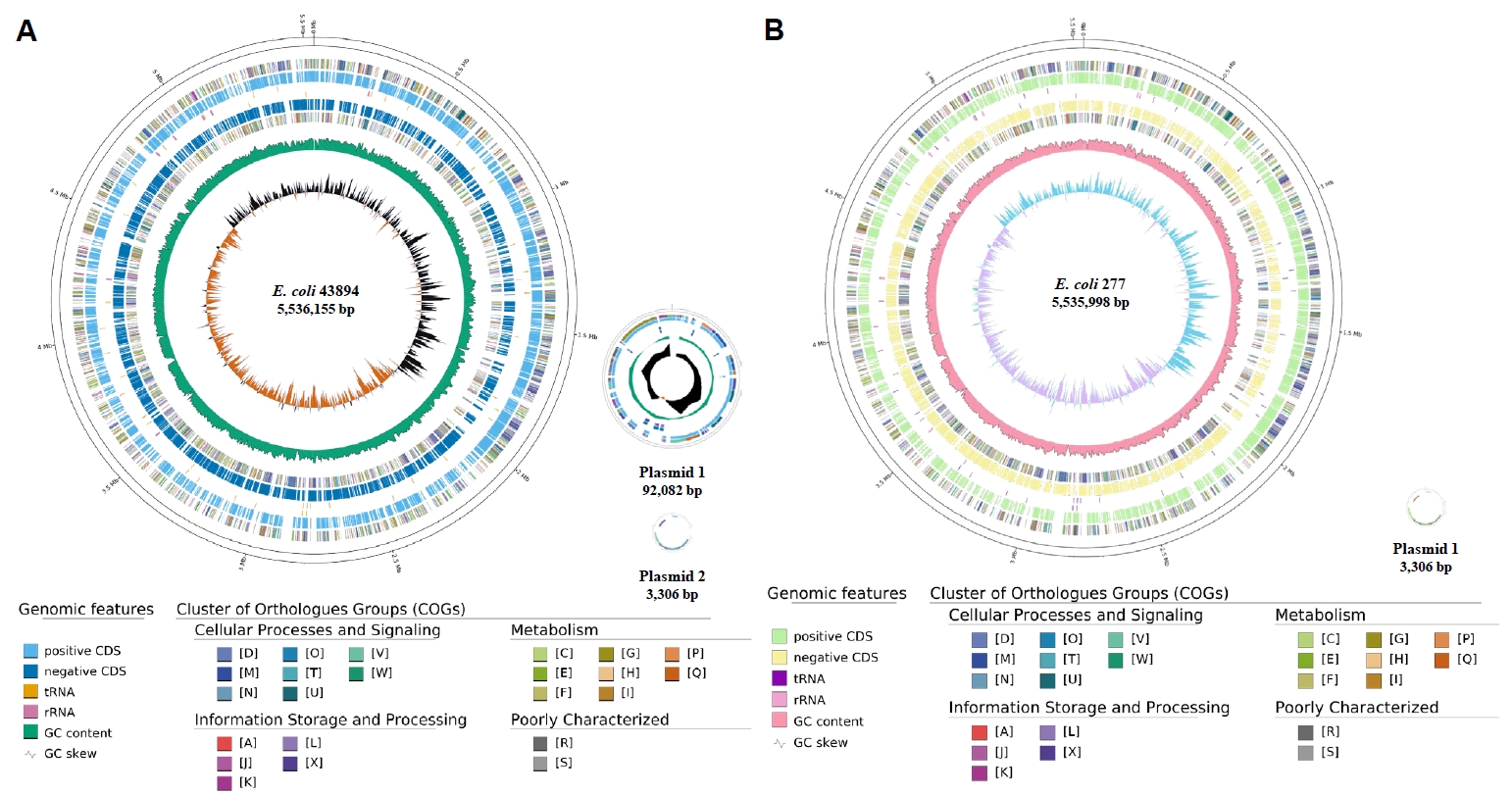
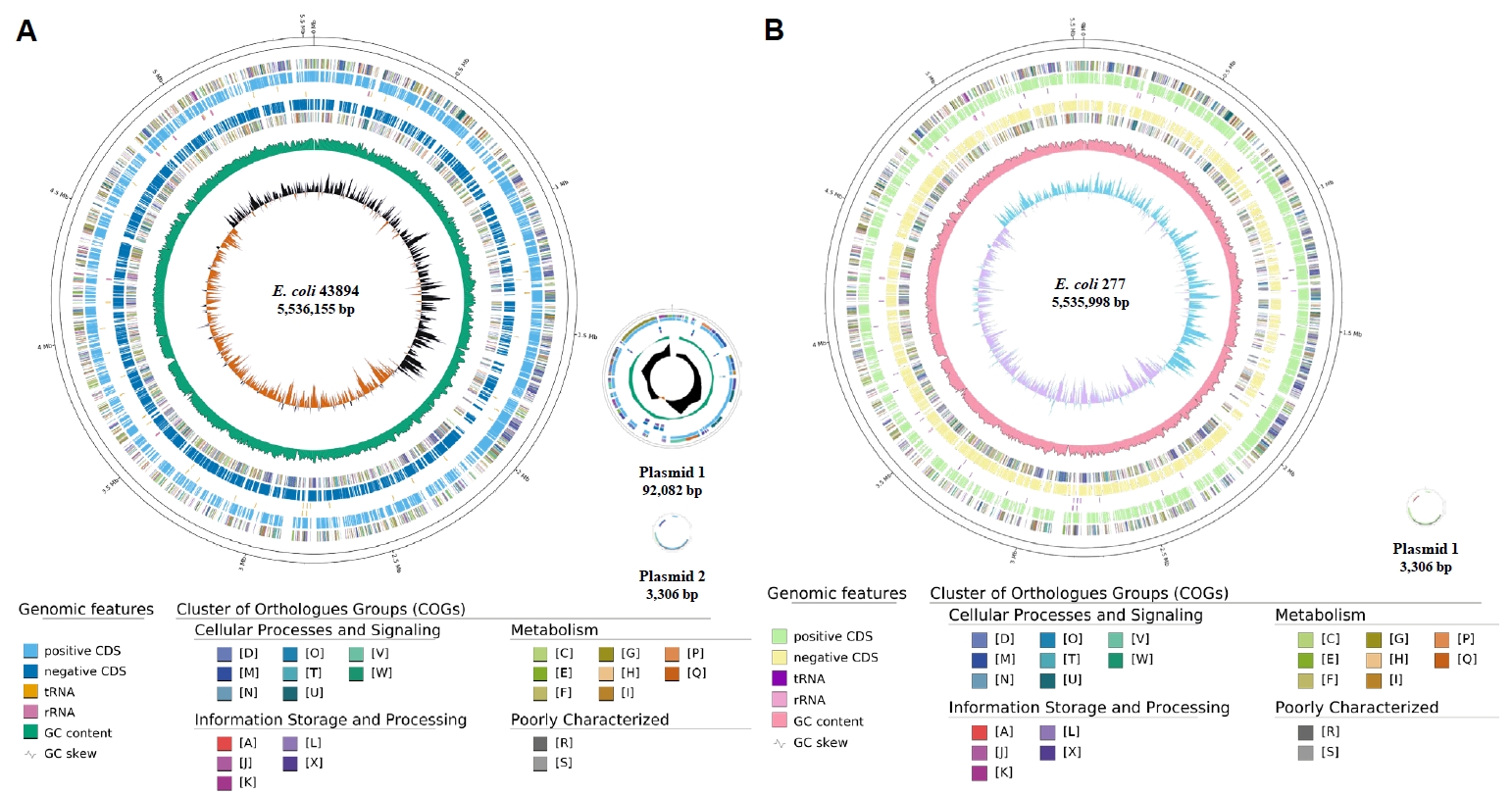
We first performed the whole genome sequencing for ATCC 43894 and 277. As shown in Fig. 1, a total of three contigs with 5,631,543 bases were obtained from de novo assembly of ATCC 43894 genome: a chromosome (5,536,155 bp) and two plasmids (92,082 and 3,306 bp). The number of coding sequences (CDSs), ribosomal RNAs (rRNAs), and transfer RNAs (tRNAs) were 5419, 22, and 104, respectively. The G + C ratio of 43894 gDNA was 50.42% (chromosome, 50.47%; plasmid 1, 47.64%; plasmid 2, 43.41%). As for the strain 277 genome, two contigs with 5,539,304 bases were obtained from de novo assembly: a chromosome (5,535,998 bp) and a plasmid (3,306 bp). The number of CDSs, rRNAs, and tRNAs were 5328, 22 and 104, respectively; the fewer CDSs in 277 reflect the number of missing CDSs from pO157. The G + C ratio of 277 gDNA was 50.46% (chromosome, 50.46%; plasmid 1, 43.41%), similar to that of 43894 gDNA. The minute difference may be due to the presence of the virulence plasmid pO157 in 43894, as its presence lowered the overall G + C ratio. Collectively, the whole genome sequencing revealed that EHEC O157:H7 strains ATCC 43894 and 277 are sequentially similar to one another, and that 277 is indeed cured of the virulence plasmid pO157.
Pan-genomic comparison between ATCC 43894 and 277
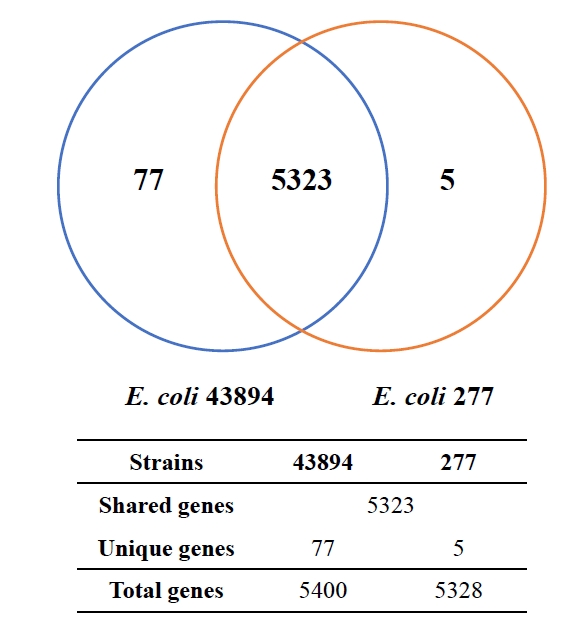
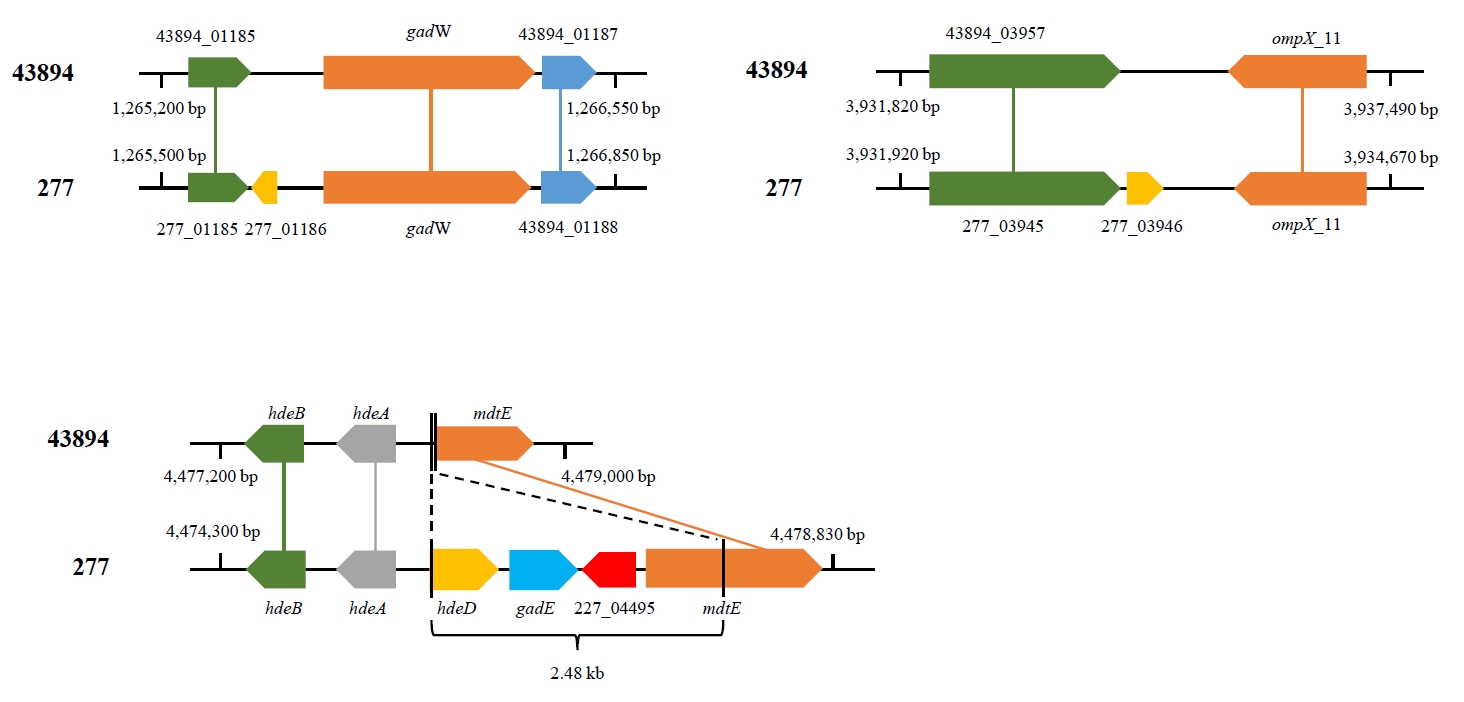
Next, we compared ATCC 43894 and 277 genome sequences to one another to identify genetic differences. As shown in Fig. 2, both strains shared 5323 core genes, whereas 77 genes and 5 genes found only in ATCC 43894 and 277, respectively. Genes found only in ATCC 43894 were closely related to those genes found in pO157, including type II secretion system genes and toxin-antitoxin ccdA-ccdB (Table S1). Genes found only in 277 were three hypothetical genes, acid-resistance protein hdeD and transcription regulator gadE. Two hypothetical genes found only in 277 (277_01186 and 277_03946) were located in adjacent to gadW and ompX, respectively (Fig. 3A). Notably, hdeD, gadE, a hypothetical gene (277_04495) and a 5′ portion of mdtE were deleted in ATCC 43894 genome (Fig. 3B). In addition, several phage related genes present in both strains showed genetic variations (Fig. 3C). Thorough investigations into the gene variations using BLAST revealed that ATCC 43894 genes harbored nucleotide substitutions and frameshift by insertion when compared to other E. coli O157:H7 genes, whereas 277 genes were shown to be identical to others (Table 1). These findings suggest that EHEC O157:H7 277 is not isogenic with ATCC 43894, and that malfunction of GDAR system in ATCC 43894 is due to deletion mutation in genes closely related to GDAR regulation, GadE and HdeD.
Confirmation of hdeD-gadE-mdtE in ATCC 43894 and 277
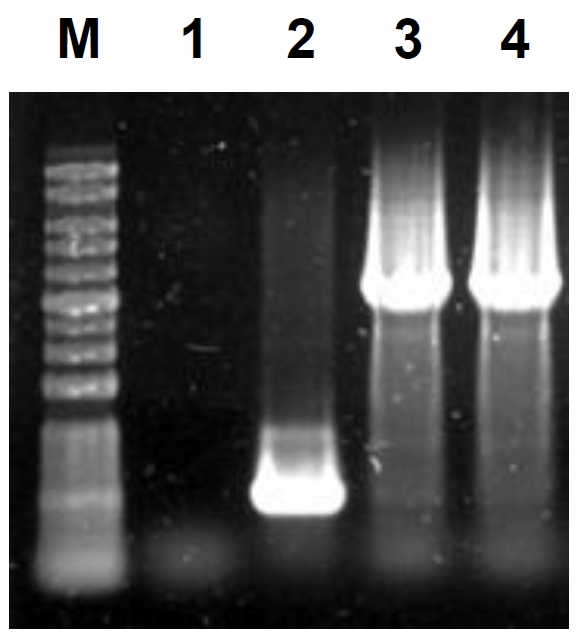
We further investigated the deletion mutation of gadE and hdeD found in the whole genome sequencing results. As depicted in Fig. 3B, ATCC 43894 is missing an approximately 2.48-kb region that consists of hdeD, gadE, a hypothetical gene and a 5′ portion of mdtE CDS in its genome as compared to that of in 277. We performed PCR to amplify the missing hdeD-gadE-mdtE region with primers targeting the adjacent sequences to confirm the mutation. As a result, ATCC 43894 formed a 500-bp band whereas other EHEC strains (277 and EDL933) formed approximately a 3.0-kb band (Fig. 4). In addition, amplified bands were ligated to a TA vector, sequenced and identified as the hdeD-gadE-mdtE region (data not shown), indicating that 43894 is missing gadE and hdeD and that whole genome sequencing performed in this study confirmed genetic variations among two strains.
EDL933 and ATCC 43894 served as reference strains for functional analyses of virulence factors and EHEC pathogenesis. Genetic variations between the reference strains confer various phenotypic traits, adding more complexity in interpretation of given experimental observations. In this study, we discovered an unexpected genetic mutation in a reference strain that had affected the previous observations.
Comparative pangenome analyses revealed that ATCC 43894 is missing two key components of GDAR, gadE and hdeD. EHEC relies on the GDAR system and a type III secretion apparatus for gut colonization. In E. coli strain Sakai, inactivation of gadE significantly downregulated many acid fitness island genes, and re-introduction of gadE recovered its acid resistance in a simulated gastric environment, clearly demonstrating its significance in bacterial survival (Kailasan Vanaja et al., 2009). Previously, Lim et al. (2007) suggested that pO157 negatively regulates the GDAR system by performing two-dimensional proteomic analyses, but our previous study suggested otherwise that the GDAR genes (gadA, gadB, gadC, gadW, and gadX) are not regulated by pO157 and the presence of pO157 does not affect GDAR of EHEC 43894 (Wi et al., 2023). Our current findings confirm that pO157 does not harbor regulatory elements that control the GDAR system and suggest that weak acid resistance observed in ATCC 43894 is due to deletion mutation of gadE and hdeD. This explains the abundance of GadAB in 277 observed in proteome and transcriptome (Lim et al., 2007), as ATCC 43894 had a defect in its expression originally. In addition, this also revealed that pO157 curing in 277 may not have originated from 43894, as hdeD-gadE-mdtE deletion is only present in ATCC 43894. Discrepancy between the two strains should be considered for future interpretation, and this finding also prompts additional investigation of pO157 in E. coli O157:H7 for its role in EHEC pathogenesis.
Nucleotide sequence and PCR analysis revealed the deletion of a 2.48-kb fragment which includes hdeD, gadE, and mdtE in ATCC 43894 genome, connecting two truncated genes hdeD and mdtE to one another (Fig. 3B). This is an unexpected observation as we could not find any potential nucleotide features such as inverted repeats and palindromic sequences adjacent to the deleted region (data not shown). One can postulate that continuous exposure to in vitro environment prompted mutations to gain fitness advantage. Continuous laboratory culture and maintenance may have led to genetic recombination in the genome, as seen in evolution of A. baumannii under controlled environment which displayed changes in biofilm formation and virulence (Yun et al., 2024). However, it is not true for ATCC 43894 as genetic recombination has not occurred in this case. In addition to the deletion, hypothetical genes in ATCC 43894 harbored several genetic mutations when compared to their counterparts in 277 (Fig. 3C), including frameshift deletion and nucleotide substitutions (Table 1). These may reflect the genetic variations that are found in other reference strains. Notably, genetic variations in E. coli rpoS gene are well documented by other research; different strains harbored different types of genetic mutation such as frameshift insertion, deletion, substitution or premature termination of rpoS gene. Variations in rpoS gene led to differential expressions of biofilm formation and acid resistance patterns in different strains of E. coli O157:H7 (Uhlich et al., 2013). We assume that spontaneous mutations may have a role in genetic variations in ATCC 43894.
Our observation also suggests that reference strains may be subjected to genomic diversification during long-term storage. Previously, genomic diversification of laboratory-stored Salmonella enterica serovar Typhimurium strain LT2 and LT7 were documented, demonstrating that long-term storage at room temperature in agar stab vials led to phenotypic and genotypic alterations including translocation and point mutations (Edwards et al., 2001; Liu et al., 2003). In addition, Sprouffske and her colleagues observed small changes in E. coli genome diversity, with ~1% of rare alleles occurring at low frequencies, but they warned that using glycerol stocks to restart may alter the future evolution of a population if the lost alleles were favorable to the microbe (Sprouffske et al., 2016). We assume that 43894 studied in this work may have favored the loss of gadE and hdeE under laboratory environment during its evolution. We would also like to provide a caution for others to check uniformity in their archival strains prior to sequencing and experimentation.
Aside from the genetic anomalies, the whole genome sequencing of ATCC 43894 and 277 revealed that the virulence plasmid pO157 was indeed missing from 277, implying that the previous study by Lim et al. (2007) addressed the role of pO157 in EHEC to a certain degree. Although pO157 is apparently not involved in regulation of the GDAR system, pO157-cured 277 showed reduced in vivo colonization and changes in expression of several proteins such as a tryptophanase TnaA. In addition, pO157-cured E. coli Sakai strain showed fewer extracellular carbohydrates in biofilm, lower viscosity and less variation in colony morphology (Lim et al., 2010). Other studies also addressed the importance of pO157 in global gene expression, virulence and adaptation of E. coli O157:H7 (Tatsuno et al., 2001; Youn et al., 2013). It would be interesting to investigate further into the functional aspects of pO157 in E. coli O157:H7 that we may have missed in the previous observation. Taken together, we analyzed the genome sequences of a reference strain EHEC ATCC 43894 and a pO157-cured strain 277 and found that ATCC 43894 harbors genetic mutations affecting glutamate-dependent acid resistance system, implying that the pO157-cured EHEC 277 may not be isogenic to ATCC 43894. This is the first report that such genetic differences between both reference strains of EHEC should be considered in future studies on pathogenic E. coli.
The online version contains supplementary material available at https://doi.org/10.71150/jm.2511015.
Fig. 1.
Complete genomes of EHEC O157:H7 strains 43894 and 277. Circular maps of three contigs from 43894 (A) and 2 contigs from 277 (B). Each circular map was drawn by applying the contig annotation information. Marked genomic features are shown from outside to inside; Clusters of Orthologues Groups (COG), positive coding sequence (CDS), negative CDS, tRNA, rRNA, G + C ratio and G + C skew. COGs are shown in colors in accordance with the COG categories: D, Cell cycle control, cell division, chromosome partitioning; M, Cell wall/membrane/envelope biogenesis; N, Cell motility; O, Posttranslational modification, protein turnover, chaperones; T, Posttranslational modification, protein turnover, chaperones; U, Intracellular trafficking, secretion, and vesicular transport; V, Defense mechanisms; W, Extracellular structures; A, RNA processing and modification; J, Translation, ribosomal structure and biogenesis; K, Transcription; L, Replication, recombination and repair; X, nan; C, Energy production and conversion; E, Amino acid transport and metabolism; F, Nucleotide transport and metabolism; G, Carbohydrate transport and metabolism; H, Coenzyme transport and metabolism; I, Lipid transport and metabolism; P, Inorganic ion transport and metabolism; Q, Secondary metabolites biosynthesis, transport and catabolism; R, General function prediction only; S, Function unknown.
jm-2511015f1.jpg
Fig. 2.
Pangenome comparison of EHEC O157:H7 strains 43894 and 277. A Venn diagram depicts the number of gene clusters shared among 43894 and 277. Each circle represents a sample, and the numbers in the circles or the overlapping area denote the number of gene clusters in each strain or shared among the samples.
jm-2511015f2.jpg
Fig. 3.
Difference in genetic composition between two EHEC O157:H7 strains 43894 and 277. Gene alignment, curation and comparative sequence analyses of two EHEC strains were performed manually using BLASTn. (A) Identification of hypothetical genes in the strain 277. (B) Deletion of hdeD-gadE-mdtE region in 43894. (C) Genetic variations in the phage-associated genes.
jm-2511015f3.jpg
Fig. 4.
Confirmation of hdeD-gadE-mdtE mutation in EHEC O157:H7 strains 43894 and 277. The hdeD-gadE-mdtE region from the genomic DNA was amplified using two primers targeting sequences adjacent to hdeD and mdtE. PCR products were visualized on a 2% agarose gel. M, 1.0-kb DNA ladder; 1, negative control; 2, 43894; 3, 277; 4, EDL933.
jm-2511015f4.jpg
Table 1.
Genetic variations found in ATCC 43894 and 277 phage genes
277 gene Gene annotationb 43894 contig/gene Mutation Sequence variationa Note
277_02321 ORM96_01890 (phage portal gene) 43894_02325 Frameshift c.544_545insA
43894 contig 1 Frameshift g.2314165_2314166insT
43894_02324 Frameshift c.371_372insC
43894_02323 Frameshift c.902_903insA
277_02325 ORM96_01910 (terminase small subunit) 43894_02331 Frameshift c.390_391insC Overlapping with 43894_02330 c.479_480insG
43894_02330 Frameshift c.479_480insG
277_02324 ORM96_01905 (terminase large subunit) 43894_02330 Frameshift c.56_57insA
Frameshift c.263_264insG Overlapping with 43894_02331 c.390_391insC
43894_02329 Frameshift c.403_404insT Overlapping with 43894_02328 c.39_40insT
Substitution c.488T > C
Substitution c.508A > C
Substitution c.519T > C
Substitution c.525A > G
Substitution c.541T > C
Substitution c.546G > T
Substitution c.558C > T
Substitution c.564G > C
Substitution c.573T > G
Substitution c.576G > T
Substitution c.606G > A
Substitution c.642T > C
Substitution c.666T > G
Frameshift c.946_947insC
277_02334 ORM96_26320 (DUF1737 domain-containing protein) 43894_02342 Frameshift c.584_585insG
43894_02341 Frameshift c.926_927insG
277_02341 ORM96_26280 (RusA family crossover junction endodeoxyribonuclease) 43894_02349 Frameshift c.187delC
277_02340 ORM96_26280 (bacteriophage antitermination protein Q) 43894 contig 1 Frameshift g.2327535_2327536insG
43894 contig 1 Frameshift g.2327438delG
277_02349 ORM96_26240 (ATP-binding protein) 43894_02359 Frameshift c.210_211insT
43894 contig 1 Frameshift g.2332332_2332333insG
277_02350 ORM96_26235 (helix-turn-helix domain-containing protein) 43894_02362 Frameshift c.274_275insA Overlapping with 43894_02361 c.6_7insA
43894_02361 Frameshift c.6_7insA Overlapping with 43894_02362 c.274_275insA
Frameshift c.285delT
43894 contig 1 Frameshift g.2332991_2332992insC
43894_02360 Frameshift c.35_36insG

aGenetic mutations and their locations denoted as follows: c, coding sequence; g, genomic DNA; ins, insertion; del, deletion; >, nucleotide substitution.

bAnnotated using BLASTn against E. coli O157:H7 EDL933 (taxid: 155864) GenBank CP111105.1.

  • An YW, Choi YS, Yun MR, Choi C, Kim SY. 2022. Characterization and validation of an alternative reference bacterium Korean Pharmacopoeia Staphylococcus aureus strain. J Microbiol. 60: 187–191. ArticlePubMedPMCPDF
  • Edwards K, Linetsky I, Hueser C, Eisenstark A. 2001. Genetic variability among archival cultures of Salmonella typhimurium. FEMS Microbiol Lett. 199: 215–219. ArticlePubMed
  • Kailasan Vanaja S, Bergholz TM, Whittam TS. 2009. Characterization of the Escherichia coli O157:H7 Sakai gadE regulon. J Bacteriol. 191: 1868–1877. ArticlePubMedPDF
  • Kim SK, Lee JB, Yoon JW. 2022. Characterization of transcriptional activities at a divergent promoter of the type VI secretion system in enterohemorrhagic Escherichia coli O157:H7. J Microbiol. 60: 928–934. ArticlePubMedPDF
  • Lee MS, Kim MH, Tesh VL. 2013. Shiga toxins expressed by human pathogenic bacteria induce immune responses in host cells. J Microbiol. 51: 724–730. ArticlePubMedPDF
  • Lee KS, Park JY, Jeong YJ, Lee MS. 2023. The fatal role of enterohaemorrhagic Escherichia coli shiga toxin-associated extracellular vesicles in host cells. J Microbiol. 61: 715–727. ArticlePubMedPDF
  • Lim JY, La HJ, Sheng H, Forney LJ, Hovde CJ. 2010. Influence of plasmid pO157 on Escherichia coli O157:H7 Sakai biofilm formation. Appl Environ Microbiol. 76: 963–966. ArticlePubMedPDF
  • Lim JY, Sheng H, Seo KS, Park YH, Hovde CJ. 2007. Characterization of an Escherichia coli O157:H7 plasmid O157 deletion mutant and its survival and persistence in cattle. Appl Environ Microbiol. 73: 2037–2047. ArticlePubMedPMCPDF
  • Liu GR, Edwards K, Eisenstark A, Fu YM, Liu WQ, et al. 2003. Genomic diversification among archival strains of Salmonella enterica serovar Typhimurium LT7. J Bacteriol. 185: 2131–2142. ArticlePubMedPMCPDF
  • Seemann T. 2014. Prokka: rapid prokaryotic genome annotation. Bioinformatics. 30: 2068–2069. ArticlePubMedPDF
  • Sprouffske K, Aguilar-Rodríguez J, Wagner A. 2016. How archiving by freezing affects the genome-scale diversity of Escherichia coli populations. Genome Biol Evol. 8: 1290–1298. ArticlePubMedPMC
  • Tatsuno I, Horie M, Abe H, Miki T, Makino K, et al. 2001. toxB gene on pO157 of enterohemorrhagic Escherichia coli O157:H7 is required for full epithelial cell adherence phenotype. Infect Immun. 69: 6660–6669. ArticlePubMedPMCPDF
  • Uhlich GA, Chen CY, Cottrell BJ, Hofmann CS, Dudley EG, et al. 2013. Phage insertion in mlrA and variations in rpoS limit curli expression and biofilm formation in Escherichia coli serotype O157:H7. Microbiology. 159: 1586–1596. ArticlePubMed
  • Uhlich GA, Paoli GC, Chen CY, Cottrell BJ, Zhang X, et al. 2016. Whole-genome sequence of Escherichia coli serotype O157:H7 strain EDL932 (ATCC 43894). Genome Announc. 4: e00647-16.ArticlePubMedPMCPDF
  • Walker BJ, Abeel T, Shea T, Priest M, Abouelliel A, et al. 2014. Pilon: an integrated tool for comprehensive microbial variant detection and genome assembly improvement. PLoS One. 9: e112963.ArticlePubMedPMC
  • Wells JG, Davis BR, Wachsmuth IK, Riley LW, Remis RS, et al. 1983. Laboratory investigation of hemorrhagic colitis outbreaks associated with a rare Escherichia coli serotype. J Clin Microbiol. 18: 512–520. ArticlePubMedPMCPDF
  • Wi SM, Kim SK, Lee JB, Yoon JW. 2023. Acid tolerance of enterohemorrhagic Escherichia coli O157:H7 strain ATCC 43894 and its relationship with a large virulence plasmid pO157. Vet Microbiol. 284: 109833.ArticlePubMed
  • Wick RR, Judd LM, Gorrie CL, Holt KE. 2017. Unicycler: resolving bacterial genome assemblies from short and long sequencing reads. PLoS Comput Biol. 13: e1005595.ArticlePubMedPMC
  • Youn M, Lee KM, Kim SH, Lim J, Yoon JW, et al. 2013. Escherichia coli O157:H7 LPS O-side chains and pO157 are required for killing Caenorhabditis elegans. Biochem Biophys Res Commun. 436: 388–393. ArticlePubMed
  • Yun S, Min J, Han S, Sim HS, Kim SK, et al. 2024. Experimental evolution under different nutritional conditions changes the genomic architecture and virulence of Acinetobacter baumannii. Commun Biol. 7: 1274.ArticlePubMedPMCPDF

Figure & Data

References

    Citations

    Citations to this article as recorded by  

      • ePub LinkePub Link
      • Cite this Article
        Cite this Article
        export Copy Download
        Close
        Download Citation
        Download a citation file in RIS format that can be imported by all major citation management software, including EndNote, ProCite, RefWorks, and Reference Manager.

        Format:
        • RIS — For EndNote, ProCite, RefWorks, and most other reference management software
        • BibTeX — For JabRef, BibDesk, and other BibTeX-specific software
        Include:
        • Citation for the content below
        Comparative genome analysis of enterohemorrhagic Escherichia coli ATCC 43894 and its pO157-cured strain 277
        J. Microbiol. 2025;63(12):e2511015  Published online December 31, 2025
        Close
      • XML DownloadXML Download
      Figure
      Comparative genome analysis of enterohemorrhagic Escherichia coli ATCC 43894 and its pO157-cured strain 277
      Image Image Image Image
      Fig. 1. Complete genomes of EHEC O157:H7 strains 43894 and 277. Circular maps of three contigs from 43894 (A) and 2 contigs from 277 (B). Each circular map was drawn by applying the contig annotation information. Marked genomic features are shown from outside to inside; Clusters of Orthologues Groups (COG), positive coding sequence (CDS), negative CDS, tRNA, rRNA, G + C ratio and G + C skew. COGs are shown in colors in accordance with the COG categories: D, Cell cycle control, cell division, chromosome partitioning; M, Cell wall/membrane/envelope biogenesis; N, Cell motility; O, Posttranslational modification, protein turnover, chaperones; T, Posttranslational modification, protein turnover, chaperones; U, Intracellular trafficking, secretion, and vesicular transport; V, Defense mechanisms; W, Extracellular structures; A, RNA processing and modification; J, Translation, ribosomal structure and biogenesis; K, Transcription; L, Replication, recombination and repair; X, nan; C, Energy production and conversion; E, Amino acid transport and metabolism; F, Nucleotide transport and metabolism; G, Carbohydrate transport and metabolism; H, Coenzyme transport and metabolism; I, Lipid transport and metabolism; P, Inorganic ion transport and metabolism; Q, Secondary metabolites biosynthesis, transport and catabolism; R, General function prediction only; S, Function unknown.
      Fig. 2. Pangenome comparison of EHEC O157:H7 strains 43894 and 277. A Venn diagram depicts the number of gene clusters shared among 43894 and 277. Each circle represents a sample, and the numbers in the circles or the overlapping area denote the number of gene clusters in each strain or shared among the samples.
      Fig. 3. Difference in genetic composition between two EHEC O157:H7 strains 43894 and 277. Gene alignment, curation and comparative sequence analyses of two EHEC strains were performed manually using BLASTn. (A) Identification of hypothetical genes in the strain 277. (B) Deletion of hdeD-gadE-mdtE region in 43894. (C) Genetic variations in the phage-associated genes.
      Fig. 4. Confirmation of hdeD-gadE-mdtE mutation in EHEC O157:H7 strains 43894 and 277. The hdeD-gadE-mdtE region from the genomic DNA was amplified using two primers targeting sequences adjacent to hdeD and mdtE. PCR products were visualized on a 2% agarose gel. M, 1.0-kb DNA ladder; 1, negative control; 2, 43894; 3, 277; 4, EDL933.
      Comparative genome analysis of enterohemorrhagic Escherichia coli ATCC 43894 and its pO157-cured strain 277
      277 gene Gene annotationb 43894 contig/gene Mutation Sequence variationa Note
      277_02321 ORM96_01890 (phage portal gene) 43894_02325 Frameshift c.544_545insA
      43894 contig 1 Frameshift g.2314165_2314166insT
      43894_02324 Frameshift c.371_372insC
      43894_02323 Frameshift c.902_903insA
      277_02325 ORM96_01910 (terminase small subunit) 43894_02331 Frameshift c.390_391insC Overlapping with 43894_02330 c.479_480insG
      43894_02330 Frameshift c.479_480insG
      277_02324 ORM96_01905 (terminase large subunit) 43894_02330 Frameshift c.56_57insA
      Frameshift c.263_264insG Overlapping with 43894_02331 c.390_391insC
      43894_02329 Frameshift c.403_404insT Overlapping with 43894_02328 c.39_40insT
      Substitution c.488T > C
      Substitution c.508A > C
      Substitution c.519T > C
      Substitution c.525A > G
      Substitution c.541T > C
      Substitution c.546G > T
      Substitution c.558C > T
      Substitution c.564G > C
      Substitution c.573T > G
      Substitution c.576G > T
      Substitution c.606G > A
      Substitution c.642T > C
      Substitution c.666T > G
      Frameshift c.946_947insC
      277_02334 ORM96_26320 (DUF1737 domain-containing protein) 43894_02342 Frameshift c.584_585insG
      43894_02341 Frameshift c.926_927insG
      277_02341 ORM96_26280 (RusA family crossover junction endodeoxyribonuclease) 43894_02349 Frameshift c.187delC
      277_02340 ORM96_26280 (bacteriophage antitermination protein Q) 43894 contig 1 Frameshift g.2327535_2327536insG
      43894 contig 1 Frameshift g.2327438delG
      277_02349 ORM96_26240 (ATP-binding protein) 43894_02359 Frameshift c.210_211insT
      43894 contig 1 Frameshift g.2332332_2332333insG
      277_02350 ORM96_26235 (helix-turn-helix domain-containing protein) 43894_02362 Frameshift c.274_275insA Overlapping with 43894_02361 c.6_7insA
      43894_02361 Frameshift c.6_7insA Overlapping with 43894_02362 c.274_275insA
      Frameshift c.285delT
      43894 contig 1 Frameshift g.2332991_2332992insC
      43894_02360 Frameshift c.35_36insG
      Table 1. Genetic variations found in ATCC 43894 and 277 phage genes

      Genetic mutations and their locations denoted as follows: c, coding sequence; g, genomic DNA; ins, insertion; del, deletion; >, nucleotide substitution.

      Annotated using BLASTn against E. coli O157:H7 EDL933 (taxid: 155864) GenBank CP111105.1.


      Journal of Microbiology : Journal of Microbiology
      TOP